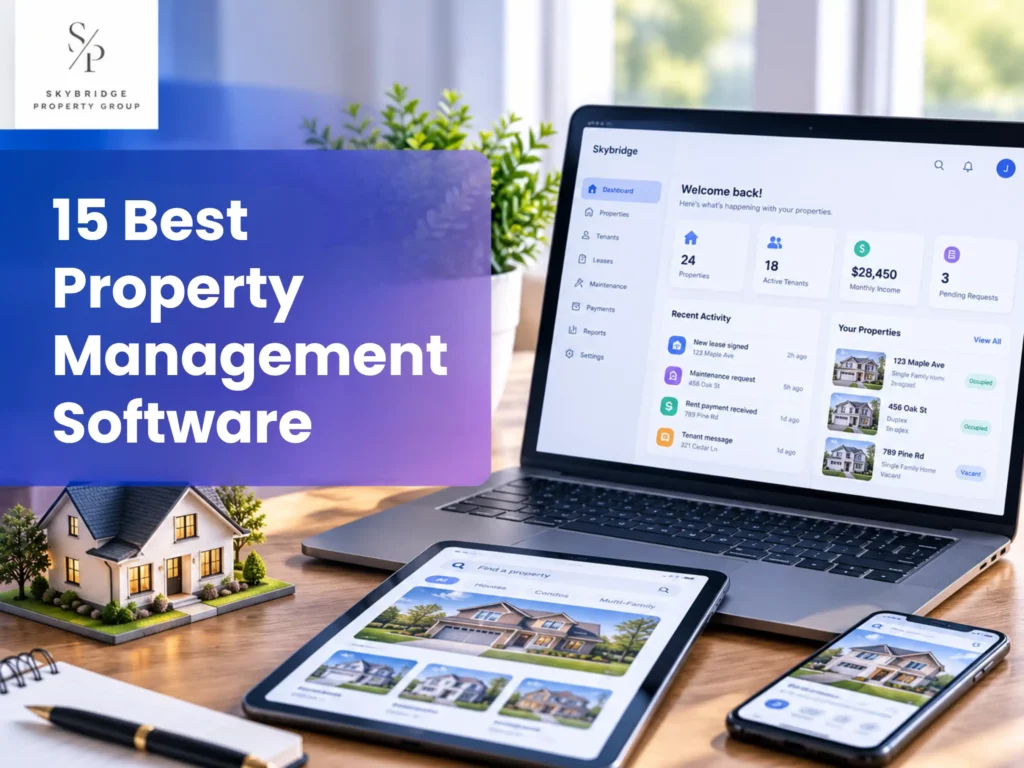
The best property management software includes Buildium, AppFolio Property Manager, Rent Manager, Yardi Voyager, MRI Software, DoorLoop, Entrata, Rentec Direct, Yardi Breeze, TenantCloud, TurboTenant, Innago, Hemlane, Avail, and Stessa. Buildium and AppFolio support professional property managers, whereas Yardi Voyager and MRI Software address more complex portfolios. In contrast, Avail, TurboTenant, and Innago focus on independent landlords, while Stessa emphasizes rental finances and portfolio performance.
Since each platform serves different management needs, compare your property type, portfolio size, required tasks, scalability, integrations, and total cost alongside essential features such as leasing, rent collection, maintenance, accounting, communication, reporting, and tenant screening. The right software can centralize these daily operations and reduce manual work, but it cannot perform physical inspections or resolve every on-site issue. Therefore, consider both your software requirements and the level of hands-on property management your rentals require.
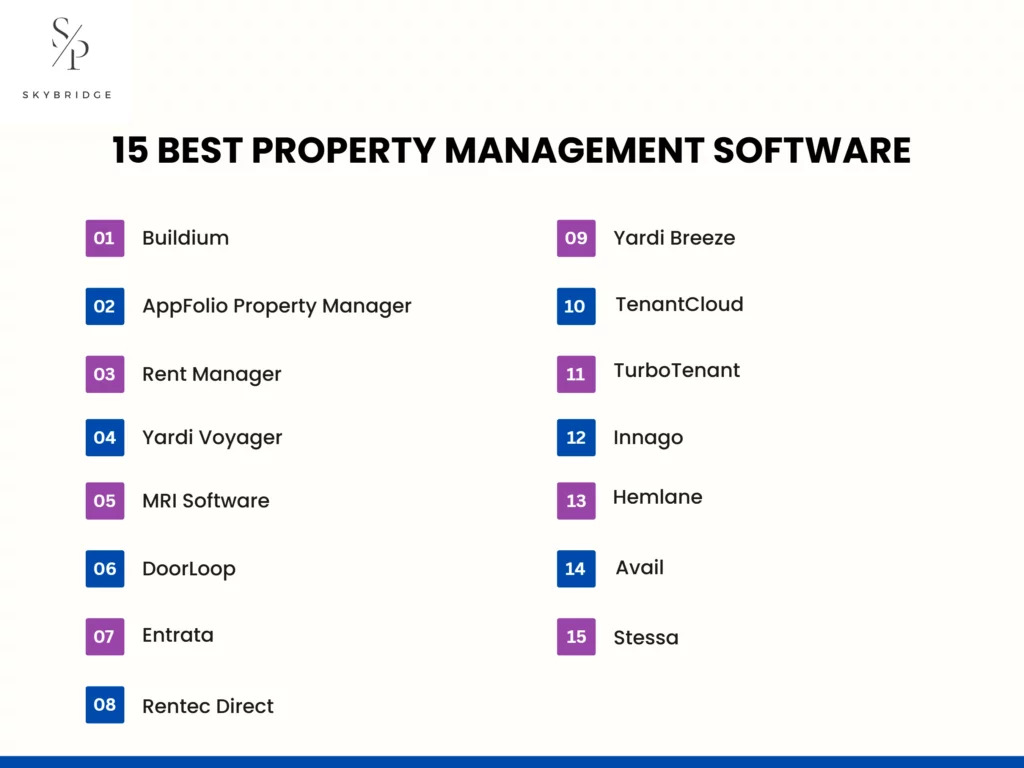
15 best property management software are:
- Buildium
- AppFolio Property Manager
- Rent Manager
- Yardi Voyager
- MRI Software
- DoorLoop
- Entrata
- Rentec Direct
- Yardi Breeze
- TenantCloud
- TurboTenant
- Innago
- Hemlane
- Avail
- Stessa
| Software | Best For | Starting Price | Free Plan | Portfolio Size | Key Strength |
| Buildium | Property management companies | $62/month | No | Growing portfolios | Accounting and operations |
| AppFolio | Professional property managers | Custom quote | No | Larger portfolios | Automation and portfolio operations |
| Innago | Independent landlords | $0 | Yes | Small to midsize | Free core property management |
| TurboTenant | DIY landlords | $0 | Yes | Small portfolios | Leasing and rental listings |
| Stessa | Rental property investors | $0 | Yes | Small to large | Rental accounting and finances |
- Buildium
Buildium is an all-in-one property management platform for rental owners and management companies that need accounting, leasing, maintenance, resident communication, owner reporting, online payments, tenant screening, eSignatures, and property-level reporting in one system. It is particularly suitable for growing residential portfolios and professional managers who have moved beyond spreadsheets or basic landlord tools.
Common use cases include rent collection, vacancy marketing, bookkeeping, maintenance tracking, lease administration, and owner statements. Pricing starts at $62 per month for Essential, $192 for Growth, and $400 for Premium. As reported in Buildium’s Property Management by Design customer case study, the company reduced quarterly HOA reconciliation time by more than 80% and grew to 1,350+ doors without adding significant staff. These findings show how Buildium property management software can help growing portfolios scale operations by automating accounting, centralizing property workflows, and reducing administrative work.
- AppFolio Property Manager
AppFolio Property Manager is designed for professional operators managing larger residential portfolios, including multifamily, single-family, affordable, and student housing. Core features include property accounting, leasing and marketing, work orders, inspections, unit turns, integrated communications, purchase orders, reporting, integrations, and Realm-X AI tools.
It suits owners and management companies with 50 or more units that need structured workflows across several employees or locations. Typical use cases include portfolio-wide leasing, maintenance scheduling, automated accounts payable, financial reporting, resident communication, and operational automation. In an AppFolio customer case study, Key Property Management grew to 1,600+ units, reported 14% year-over-year unit growth, and saved 20 to 30 hours per week through Automated AP. These results show how integrated accounting and workflow automation can support portfolio growth while reducing time spent on manual invoice processing.
- Rent Manager
For professional owners and property management companies needing greater customisation, Rent Manager is configurable property management software that combines accounting, leasing, maintenance, reporting, work orders, online applications, eSignatures, owner and tenant portals, vendor management and custom workflows. Its Plus package adds mobile tools and AI-powered AR/AP functions, while Premium includes video inspections, maintenance scheduling, AI-powered report analysis, and dedicated customer success support. Basic, Plus, and Premium pricing is available by custom quote.
To support different operational requirements, Rent Manager serves residential, commercial, manufactured housing, student housing, self-storage, and other property types. The platform also connects with more than 200 integrated providers, while Orion AI supports receipt capture, invoice processing, communication drafting, and financial workflows. Together, these features give property managers flexible accounting, custom workflows, mobile operations, and broad integration options.
- Yardi Voyager
Yardi Voyager is an enterprise property management and accounting platform built for larger organizations managing complex real estate portfolios. It brings property operations, accounting, leasing, maintenance, analytics, dashboards, compliance workflows, and AI-supported automation into a connected database. The platform supports multifamily, commercial, affordable housing, student housing, senior living, manufactured housing, public housing, and mixed portfolios.
This broad operational coverage makes Voyager particularly relevant to institutional owners, large operators, REITs, and management companies that require portfolio-wide controls and detailed financial reporting. In Yardi’s Othrys customer story, the commercial property operator reported 80% less time spent on invoicing, 50% less time on bill payments, and 50% less time on direct debits, collections, and related processes, along with a 30% reduction in collections after centralizing operations in Voyager. The case shows how connected accounting, leasing, maintenance, and portfolio data can reduce manual processing across large property portfolios.
- MRI Software
MRI Software is a real estate technology provider whose MRI Property Management X (MRI PMX) property management software is designed for owners and operators managing complex residential, commercial, industrial, retail, affordable housing, and mixed-use portfolios. The platform combines property accounting, financial management, lease administration, operational workflows, configurable reporting, forecasting, APIs, data import and export, integrations, and AI-powered portfolio insights.
According to MRI Software’s Property Management X product page, its technology supports 15 million residential units, 5 million commercial leases, and 3 million subsidized housing units. The same page highlights a Growthpoint Properties case study in which report creation time dropped from 3 weeks to under 2 hours after MRI consolidated financial data. These figures demonstrate MRI PMX’s scale and its potential to significantly streamline financial reporting across large property portfolios.
- DoorLoop
When landlords and property managers need to centralize daily operations, DoorLoop is property management software that combines rent collection, accounting, tenant screening, leasing, maintenance, listings, portals, communications, reporting, and workflow automation. It supports residential, commercial, affordable housing, and community association portfolios. Current annual promotional pricing starts at $69 per month for Starter, $149 for Pro, and $209 for Premium.
As portfolios grow, DoorLoop can replace separate systems for payments, leasing, maintenance, and communications. Common uses include automated rent collection, tenant screening, lease renewals, bookkeeping, and vacancy marketing. In DoorLoop’s customer stories, Lumbu Management, which manages more than 150 residential units, reports saving approximately 20 to 25 hours per week with the platform. This illustrates how centralized workflows can reduce repetitive administrative work as portfolios expand.
- Entrata
Entrata is enterprise property management software built primarily for multifamily operators that need accounting, payments, leasing, maintenance, renewals, resident communication, reporting, and portfolio operations in one connected platform. It also supports student, affordable, military, commercial, and manufactured housing, while its 2026 platform includes more than 100 embedded AI agents for automating property management workflows.
It suits larger operators that need centralized controls, resident self-service, and high-volume automation across multiple properties. According to Entrata’s “Bill Pay Case Study | Entrata x PeakMade,” PeakMade automated nearly 2,500 resident refund checks with Entrata Bill Pay and saved more than 300 staff hours during student move-out season. Pricing is not publicly listed and is available through direct consultation. Overall, Entrata provides larger property operators with scalable property management software to centralize complex workflows and reduce high-volume administrative work.
- Rentec Direct
For independent landlords and professional property managers, Rentec Direct is property management software that combines rental accounting, online rent collection, tenant screening, maintenance tracking, vacancy marketing, bank syncing, financial reporting, and mobile access. Rentec PM adds owner accounting, an owner portal, ACH owner payments, and trust accounting. Starter costs $25 per month for up to 10 properties, while Pro and PM start at $50 per month, with free setup and onboarding.
According to Rentec Direct’s “The Digital Shift in Rent Payments: A Decade of Data and Insights” report, which analyzed $21.9 billion in payments from more than 1.2 million tenants, offline renters were 23% more likely to pay late than online renters. This shows how Rentec Direct property management software can support more efficient rent collection by integrating digital payment tools into property management workflows.
- Yardi Breeze
Yardi Breeze is cloud-based property management software for small and mid-sized operators, combining property accounting, leasing, online applications, rent payments, maintenance, tenant communication, vendor payments, and owner reporting. Residential Breeze starts at $1 per unit monthly with a $100 minimum, while Breeze Premier has a $400 monthly minimum and adds corporate accounting, CRM, invoice processing, customizable financial statements, and automation.
By bringing property accounting, leasing, payments, maintenance, and tenant communication into one platform, Yardi Breeze can reduce the need to manage daily operations across separate systems. This efficiency is reflected in Yardi’s “Save 20 Hours A Week With Property Management Software?” customer story, where Capstone Communities reported saving 15 to 20 hours per week while managing about 200 doors with Breeze Premier. This example shows how integrated property management software can reduce administrative workload and create more time for portfolio growth.
- TenantCloud
When landlords and property managers bring more tasks in-house, TenantCloud is property management software for rent collection, tenant screening, maintenance, accounting, inspections, and owner portals. All plans support unlimited properties and units, with active lease limits from 10 on Starter to 60 on Pro. Annual pricing starts at $15 per month and reaches $100 for Business.
By centralizing tenant, payment, vacancy, and financial workflows, TenantCloud can reduce reliance on separate management systems. According to its “How G5 Capital Saved $50k By Moving In-House with TenantCloud” case study, G5 Capital brought management of its 60-unit portfolio in-house and reported saving more than $50,000 annually in third-party management fees. TenantCloud can therefore serve as effective property management software for owners seeking to centralize operations, reduce management costs, and bring more portfolio tasks in-house.
- TurboTenant
TurboTenant is property management software for self-managing landlords who want rental advertising, lead management, applications, tenant screening, state-specific leases, eSignatures, online rent collection, maintenance tracking, and accounting in one platform. It is particularly suited to owners managing 1 to 50 doors. The Free plan costs $0, while Essentials ranges from $149 to $349 per year and Pro from $199 to $999 per year, depending on portfolio size.
For cost-conscious rental owners, this structure provides a path from basic self-management to more advanced accounting and automation. TurboTenant’s “State of the Rental Industry 2026” report found that about three in four landlords reported higher operating costs, making lower-cost management tools increasingly relevant for independent owners seeking to control administrative expenses. Overall, TurboTenant provides accessible property management software for independent landlords seeking to manage rental operations while controlling administrative costs.
- Innago
For rental management, Innago provides free property management software for landlords and property managers who need online rent collection, tenant screening, digital leases, maintenance tracking, tenant communication, expense reporting, and integrations. It supports residential, commercial, student housing, self-storage, affordable housing, senior living, and other portfolios with no monthly subscription, setup, or contract fees, though transaction and third-party fees may apply.
According to Innago’s “2025 Feature Usage Report,” 64% of online rent invoices were paid on time compared with 30% of offline payments, based on platform activity from July 2024 through June 2025. These findings position Innago as property management software that combines digital payment workflows with subscription-free access for rental owners and managers.
- Hemlane
Hemlane combines property management software with optional management services for landlords, including remote landlords who need local support. Its software covers rental advertising, tenant screening, eSignatures, rent collection, accounting, tenant communication, and maintenance tracking. Starter is free, while Basic starts at $2 per unit plus a $28 platform fee. Higher tiers add services such as 24/7 repair coordination, showing coordination, tenant communication, and local leasing support through Hemlane’s agent network.
This hybrid model suits rental owners who need more assistance than software alone provides. By combining property management software with repair coordination, leasing support, and tenant communication services, Hemlane allows landlords to centralize core rental operations while outsourcing selected tasks. As a result, it offers a flexible option for owners seeking both software automation and hands-on property management support.
- Avail
Avail by Realtor.com is property management software for independent landlords who want to manage rental listings, applications, TransUnion tenant screening, state-specific leases, eSignatures, online rent collection, maintenance requests, tenant communication, and income and expense tracking in one platform. The Unlimited plan is free, while Unlimited Plus costs $9 per unit per month and includes features such as FastPay, waived ACH fees, customizable applications and leases, reusable templates, property websites, and priority support.
It suits independent landlords managing smaller rental portfolios. Its listing tools can publish rental properties across 20 rental sites, including Realtor.com, Trulia, Zumper, and Rent. Avail also integrates services and features such as CreditBoost, Plaid, and Stripe within its rental-management ecosystem. According to Avail, the platform has processed more than $2 billion in rental payments, providing a stronger measure of platform usage alongside its listing and property management capabilities.
- Stessa
For landlords and real estate investors, Stessa is property management software focused on rental finances and portfolio performance. Its features include automated bank feeds, income and expense tracking, rent collection, tenant screening, leasing, eSignatures, maintenance tracking, tax-ready reports, receipt scanning, and portfolio dashboards. All plans support unlimited properties. Essentials is free, Manage Costs is $12 per month annually, and Pro costs $28 per month annually with advanced reporting, budgeting, and transaction tracking.
This financial focus makes Stessa suitable for individual owners and investors managing larger residential portfolios. According to Stessa’s July 2022 Customer Survey, users reported saving more than 100 hours and up to $4,000 per year on average. Stessa also reports 350,000+ users. Therefore, the reported time and cost savings, combined with broad adoption, indicate Stessa’s value as property management software for simplifying financial management and portfolio oversight.
What Should You Consider Before Choosing Property Management Software?
You should consider your property type, portfolio size, management needs, operational approach, scalability, integrations, and total software cost before choosing property management software. Evaluating these factors helps you select a platform that fits current workflows while supporting efficient management as your portfolio grows.
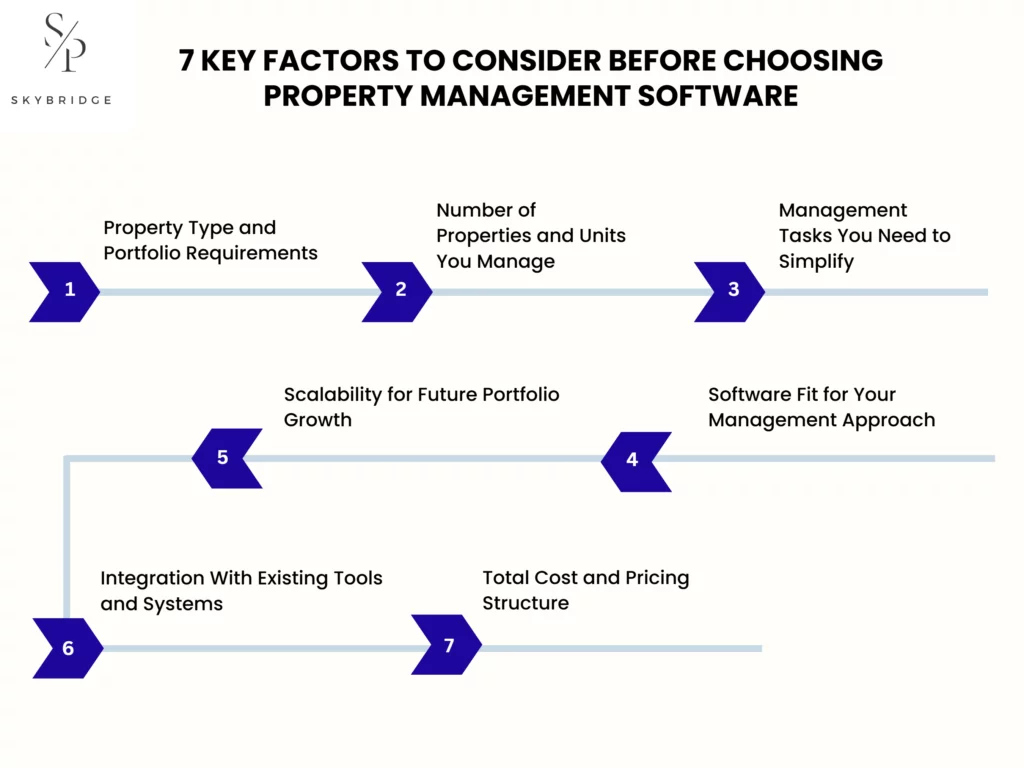
7 key factors to consider before choosing property management software are:
- Property Type and Portfolio Requirements
Start by checking whether the software supports the property types in your portfolio. Single-family rentals, multifamily buildings, commercial properties, and mixed-use portfolios can require different leasing, accounting, maintenance, and reporting functions. For example, commercial properties may require detailed lease administration, while residential portfolios may prioritize tenant screening, rent collection, and maintenance management.
- Number of Properties and Units You Manage
Calculate how many properties and individual units you currently manage because software capabilities and pricing often depend on portfolio size. Check unit limits, minimum monthly fees, user allowances, and pricing tiers. If you manage 20 units, for example, avoid paying for enterprise-level capacity unless you expect substantial portfolio growth.
- Management Tasks You Need to Simplify
Prioritize software that simplifies the management tasks consuming the most time or manual effort. Identify processes such as rent collection, accounting, tenant screening, leasing, maintenance, and reporting, then determine whether the platform can centralize or automate those specific responsibilities.
- Software Fit for Your Management Approach
Match the software to how you operate and the responsibilities you handle directly. DIY landlords need straightforward leasing and payment tools, while professional managers require owner portals, trust accounting, staff permissions, and advanced reporting for more complex operations.
- Scalability for Future Portfolio Growth
Choose property management software that can accommodate additional properties, units, users, and operational requirements as your portfolio grows. Review scalability across pricing tiers, automation, reporting, permissions, and property types to reduce the need to migrate to another platform later.
- Integration With Existing Tools and Systems
Confirm that the software can connect with the systems already supporting your property operations. Check compatibility with accounting platforms, banking systems, payment processors, listing services, and other essential tools to reduce duplicate data entry and maintain connected workflows.
- Total Cost and Pricing Structure
Calculate the total software cost based on your portfolio rather than comparing subscription prices alone. Include per-unit charges, setup fees, payment processing costs, add-ons, premium features, and future pricing changes to determine the platform’s actual cost as your requirements grow.
What Features Should You Look for in Property Management Software?
You should look for property management software with tenant and lease management, rent collection, maintenance tracking, accounting, communication, reporting, tenant screening, mobile access, integrations, and scalability. These features help centralize daily property operations, reduce manual work, improve financial oversight, and support efficient management as your portfolio grows.
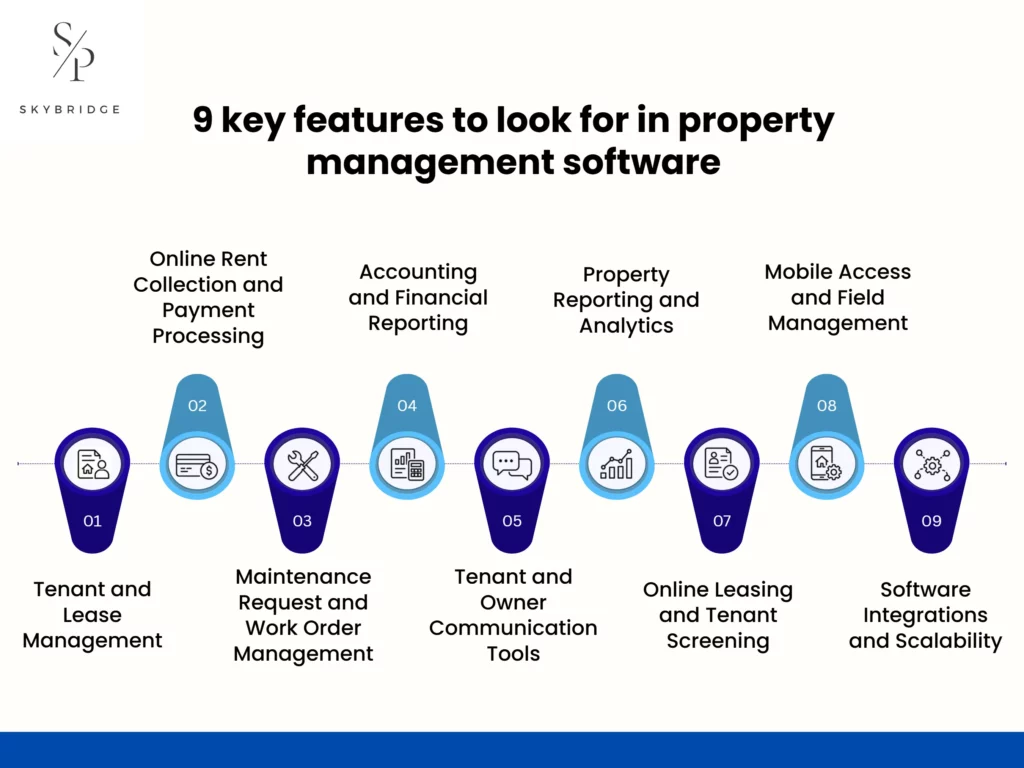
The 9 key features to look for in property management software are:
- Tenant and Lease Management
Ensure the software gives you one place to manage tenant records, lease terms, renewals, deposits, and occupancy details throughout the tenancy. Centralized records make it easier to monitor active agreements, identify upcoming lease expirations, access documents, and maintain accurate tenant information.
- Online Rent Collection and Payment Processing
Look for a payment system that lets tenants pay rent online while giving you clear control over collections and payment records. Check for recurring payments, multiple payment methods, automated reminders, late-fee management, and payment histories to reduce manual collection and tracking work.
- Maintenance Request and Work Order Management
Select a system that manages maintenance from the initial tenant request through repair completion. Tenants should be able to report issues while managers create work orders, assign tasks, track progress, communicate updates, and retain maintenance records within the same workflow.
- Accounting and Financial Reporting
Prioritize software that accurately records property income and expenses while providing the financial reports required to monitor performance. Look for transaction tracking, bank reconciliation, expense categorization, owner statements, tax-ready records, and financial reporting to keep property accounts organized and accessible.
- Tenant and Owner Communication Tools
Use software that centralizes communication with tenants and property owners instead of spreading conversations across separate channels. Tenant and owner portals, messaging, automated notifications, and announcements should help you distribute payment reminders, maintenance updates, documents, and other important information efficiently.
- Property Reporting and Analytics
Look for reporting tools that turn operational and financial data into information you can use to evaluate property performance. Review whether dashboards and reports cover occupancy, vacancies, rent collection, expenses, maintenance, and portfolio trends, with customization options to meet your specific reporting needs.
- Online Leasing and Tenant Screening
Choose software that connects applicant screening and lease execution within a single digital leasing process. Look for online applications, credit and background screening, customizable lease documents, eSignatures, and document storage to reduce manual steps between receiving an application and completing a lease.
- Mobile Access and Field Management
Ensure the platform gives you access to essential management functions when working away from your desk or visiting properties. Mobile access should support tasks such as reviewing tenant information, updating maintenance requests, completing inspections, accessing documents, and communicating with tenants or staff.
- Software Integrations and Scalability
Confirm that the software can connect with your existing systems and accommodate additional properties, units, users, and workflows as your portfolio expands. Review accounting, banking, payment, and listing integrations alongside unit limits, user permissions, automation capabilities, and higher-tier features.
How Much Does Property Management Software Cost?
Property management software costs $50 to $100 per month for many U.S. property managers, although pricing varies by portfolio size, number of units, features, users, and integrations. Property management software can cost from $0 for basic plans to $ 100+ per month, depending largely on portfolio size and included features. Many providers use per-unit pricing, commonly ranging from $1 to $5 per unit per month. Independent landlords with a few properties can often use free or low-cost plans, while larger portfolios may face monthly minimums, setup fees, transaction charges, and other costs that increase the total software expense. Compare the full cost against the software’s automation, accounting, maintenance, leasing, and reporting capabilities to determine its practical value for your portfolio.
Is Property Management Software Enough to Manage Your Rental Property?
Yes, property management software can be enough if you have the time and experience to manage your rental property yourself. It can centralize rent collection, tenant screening, leasing, accounting, maintenance requests, and communication, reducing the manual work involved in daily management. However, software cannot physically inspect properties, coordinate every on-site issue, or handle situations that require direct local involvement. If these responsibilities become difficult to manage, combining software with a local property manager can provide both digital efficiency and hands-on support.
Should You Manage Your Rental Property Yourself or Hire a Local Property Manager?
You should manage your rental property yourself if you have the time, knowledge, and resources to handle daily operations, while hiring a local property manager is better when you need hands-on support, local oversight, or less involvement. Consider your portfolio size, location, available time, management experience, and operating costs before deciding which approach fits your rental property.
Manage Your Rental Property Yourself If:
- Your portfolio is small enough to manage within your available time.
- You understand leasing, rent collection, recordkeeping, and landlord responsibilities.
- You already have reliable contractors for repairs and maintenance.
- You prefer to be directly involved in tenant and property decisions.
- Property management software can handle most of your administrative workload.
- Management costs would significantly reduce your rental returns.
Hire a Local Property Manager When:
- Your portfolio has grown beyond what you can manage efficiently.
- Distance makes regular property oversight difficult.
- Frequent tenant issues or maintenance requests require local attention.
- You need professional support with leasing, inspections, or vendor coordination.
- Managing rentals interferes with your primary work or other investments.
- You want to reduce your involvement in routine property operations.