

You should charge rent by researching similar properties in your local area and calculating whether the rental rate covers your operating expenses while remaining competitive. To determine the ideal rental price, evaluate comparable rentals and apply methods such as the 1% rule, cost-plus pricing, fair market value, and price-per-square-foot analysis, while considering factors like location, property size, condition, market demand, seasonality, operating costs, rent control laws, and lease terms.
Setting the right rent helps attract quality tenants, reduce vacancies, maximize rental profits, lower tenant turnover, stay competitive, and cover operating costs. Avoid pricing mistakes such as overpricing, underpricing, relying on listing prices or national averages, ignoring operating expenses, overvaluing upgrades, and failing to review rent regularly. You can further maximize rental income by using rent estimate tools, monitoring listing performance, making cost-effective upgrades, adding ancillary income streams, listing during peak rental seasons, pricing to minimize vacancy, and offering lease renewal incentives.
How Do You Determine the Ideal Rental Price for Your Property?
The ideal rental price for your property is determined by combining comparable rental analysis (comps), the 1% rule, cost-plus pricing, fair market value calculations, and price-per-square-foot analysis to arrive at a competitive and profitable rental rate. This comprehensive approach helps balance market demand, property expenses, and investment goals, ensuring your rental remains attractive to tenants while maximizing long-term returns.
5 key factors to determine the ideal rental price of your property are:
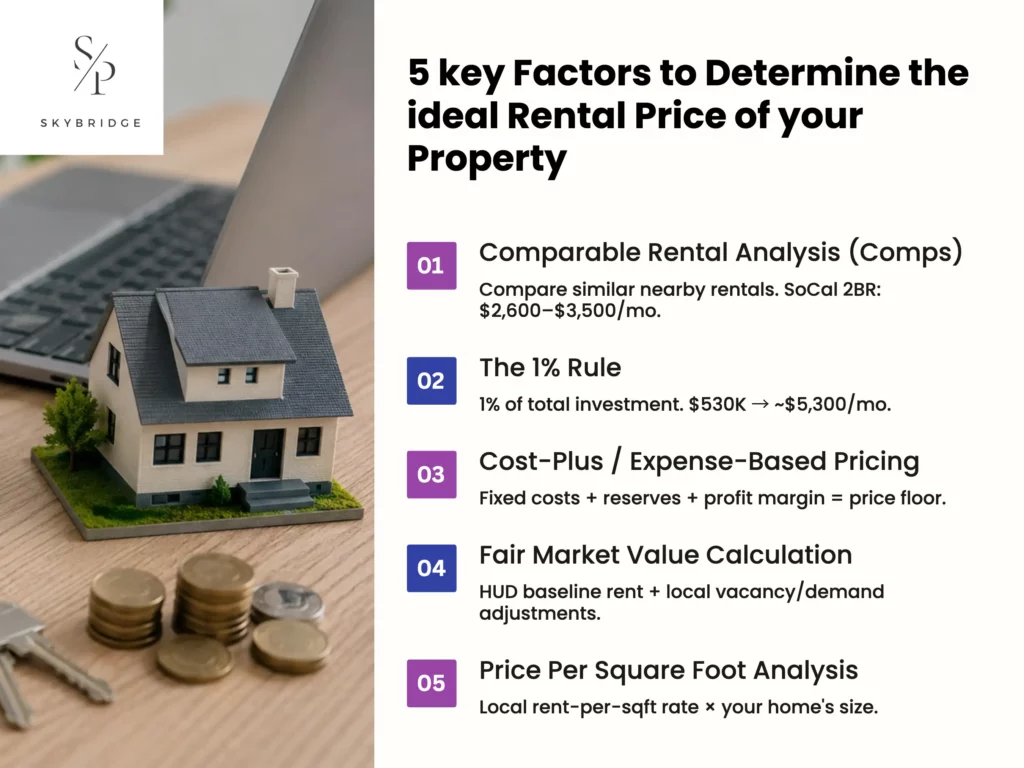
- Comparable Rental Analysis (Comps)
A comparable rental analysis (comps) estimates your property’s rental value by comparing it with similar rental properties in the same neighborhood. To ensure accurate comparisons, select properties with the same property type, similar square footage, bedroom and bathroom count, condition, amenities, and location.
For example, a standard two-bedroom apartment in Southern California commonly rents for $2,600 to $3,500 per month, while a three-bedroom single-family home rents between $3,900 and $5,500, depending on the city and neighborhood. Reviewing active listings and recently leased properties helps establish a competitive rental price that reflects current market demand and tenant expectations.
- The 1% Rule
The 1% rule is a quick rental pricing guideline that suggests your monthly rent should equal at least 1% of the property’s purchase price or current market value. To calculate the target rent, include the property’s purchase price, renovation or rehabilitation costs added to the investment basis, and multiply that total sum by 0.01 (1%).
Suppose you purchase a rental property for $500,000, invest $20,000 in renovations, and pay $10,000 in closing costs. Your total investment amounts to $530,000. Applying the 1% rule, the target monthly rent would be approximately $5,300 (1% × $530,000). This calculation offers a practical benchmark for assessing whether the property’s expected rental income supports your overall investment before factoring in local market conditions.
- Cost-Plus / Expense-Based Pricing
Expense-based pricing establishes the absolute financial floor your rental income must cover to prevent operating at a loss. Start by totaling all fixed monthly overhead, including your mortgage principal and interest, property taxes, landlord insurance, and any applicable HOA fees. To prevent unexpected repairs from wiping out your cash flow, factor in variable reserves, allocating 5% to 10% of monthly rent for ongoing maintenance, alongside dedicated buffers for property management and seasonal vacancy.
After calculating your total monthly operating baseline, add your desired net profit margin to determine the final rental price. This approach guarantees that every expense is accounted for, protecting your investment from unexpected shortfalls. However, because cost-plus pricing focuses entirely on internal expenses, you must validate the resulting number against current market demand to ensure prospective tenants will actually pay the price required to cover your costs.
- Fair Market Value Calculation
Fair Market Value (FMV) represents the price a willing tenant agrees to pay, and a willing landlord agrees to accept in an open, competitive market. A reliable foundation for determining FMV is the Department of Housing and Urban Development (HUD) annual Fair Market Rent data, which tracks baseline rates across specific metropolitan areas and zip codes. These public benchmarks provide an unbiased snapshot of regional rent distribution across different bedroom counts.
To refine HUD’s baseline into a precise price for your specific property, adjust for immediate market conditions and local economic drivers. Factor in neighborhood vacancy rates, proximity to major employment hubs or top-rated schools, and seasonal shifts, as tenant demand generally peaks during late spring and summer. Blending standardized government data with real-time local economic shifts ensures your price reflects true market equilibrium.
- Price Per Square Foot Analysis
Price per square foot analysis estimates rent by using your property’s total livable area as the basis for pricing. Begin by identifying the average rent per square foot for similar properties in the same neighborhood, ensuring they match in property type, condition, and amenities.
For instance, if you own a 1,800-square-foot single-family home in San Diego, Southern California, compare it with nearby homes of a similar size and layout. If comparable properties rent for between $4,500 and $5,200 per month, your rental price should fall within a similar range after accounting for your home’s condition and features. This method creates a standardized pricing approach and makes it easier to compare properties of different sizes while remaining competitive in the local market.
What Factors Affect How Much You Should Charge for Rent?
The factors that affect rent are location, property size and type, market value, condition, amenities, local demand, vacancy rates, seasonality, operating costs, rent control laws, and lease terms to remain competitive and financially sustainable. Evaluating these components together helps you set a rental price that aligns with current market conditions, attracts qualified tenants, and supports consistent long-term rental income.
9 key factors that affect the amount for rent are:
- Location
The location of your property has the greatest influence on how much rent you can charge because tenants often prioritize convenience, accessibility, and neighborhood quality. Properties near employment hubs, top-rated schools, shopping centers, beaches, and public transit command higher rents than those in less accessible areas.
For instance, a two-bedroom apartment in Los Angeles commonly rents for $2,800 to $3,800 per month, while a similar apartment in Long Beach rents for $2,300 to $3,100 per month because of differences in location, amenities, and demand. Comparing nearby neighborhoods helps you set a rental price that reflects local market conditions rather than applying a one-size-fits-all approach.
- Property Size & Type
When charging rent, property size and type play a significant role because larger homes and different property categories attract different tenant groups and rental expectations. In Southern California, a 1,000-square-foot two-bedroom condominium rents for $2,800 to $4,000 per month, while a 2,000-square-foot four-bedroom single-family home in the same region rents for $3,800 to $7,000 per month, with the wide spread driven mainly by whether the property sits in a coastal/urban submarket or an inland one.
The additional living space, bedrooms, privacy, and outdoor areas increase demand, making it important to price your property according to its size, category, and submarket rather than comparing it with different property types or applying one flat range across the entire region.
- Property Value
Property value influences rental pricing, as tenants are willing to pay more for homes that offer greater quality, modern features, and long-term market appeal. Recent property appraisals, neighborhood appreciation, and upgrades such as remodeled kitchens, renovated bathrooms, or energy-efficient systems can justify higher rents.
In many markets, upgraded properties can command 10% to 25% higher rent than comparable dated homes. Regularly reassessing your property’s value and investing in strategic upgrades helps keep your rental price competitive and aligned with current market conditions.
- Property Condition & Amenities
Charging rent requires evaluating your property’s condition and amenities, as these features directly influence tenant demand and rental value. In Southern California, a dated two-bedroom condominium may rent for $2,800 to $3,200 per month, while a comparable remodeled unit with updated amenities may rent for $3,200 to $4,000 per month.
Coastal markets such as Irvine and La Jolla often command higher rents than inland areas like Riverside and San Bernardino. Rent expectations also vary by property type, with single-family homes emphasizing privacy, condominiums offering shared amenities, apartments priced by unit and community features, and multi-family properties requiring each unit to be evaluated individually for competitive rental pricing.
- Local Market Demand & Vacancy Rates
Local market demand and vacancy rates affect rental pricing because higher tenant demand, combined with fewer available properties, gives landlords greater pricing flexibility. Orange County and San Diego, where vacancy rates are 2% to 4.6%, support stronger rental pricing, while the Inland Empire, with vacancy rates around 5.5% to 6.3%, requires more competitive pricing. Los Angeles County falls between these markets.
In 2025, the City of San Diego’s vacancy rate fell to 3.12%, and the Southern California Rental Housing Association reported renewed demand, lower vacancies, and rising rents, indicating a tighter landlord-favorable market (Source.SCRHA). Monitoring local rental trends, new housing developments, seasonal demand, and changes in neighborhood vacancy rates helps you adjust rent to remain competitive while maximizing occupancy and long-term rental income.
- Seasonality
Rental demand in Southern California typically peaks during the spring and summer moving season, when families, students, and job-related relocations increase competition for available units. This seasonal demand can place upward pressure on asking rents, although the magnitude of rent increases varies by city, neighbourhood, and property type. For instance, a property renting for $3,000 per month during slower seasons commands $3,300 to $3,450 per month during peak leasing months as families, students, and professionals relocate.
During off-peak seasons, rents may decline by 5% to 10%, requiring more flexible pricing, lease incentives, or favorable lease terms to attract tenants. Monitoring seasonal rental trends helps property owners adjust pricing, reduce vacancies, and maintain consistent occupancy throughout the year.
- Operating Costs
Operating costs are the recurring expenses required to maintain and operate a rental property, making them an essential factor when determining how much rent to charge. Common operating costs include property taxes, homeowners insurance, maintenance and repairs, and landlord-paid utilities, all of which contribute to the property’s ongoing ownership costs.
As an illustration, a Southern California property renting for $3,000 per month may incur approximately $1,180 in monthly operating costs, including about $380 in property taxes, $150 in insurance, $500 in maintenance, and $150 in utilities, before mortgage payments or profit are considered. Including operating costs in your rent calculation helps ensure the rental income covers essential expenses while keeping your pricing competitive and financially sustainable.
- Rent Control & Local Regulations
Rent control and local regulations directly affect how much rent a landlord can legally charge by establishing rules for rent increases and tenant protections. Under California’s Tenant Protection Act (AB 1482), many qualifying properties are subject to annual rent increase limits of 5% plus the local Consumer Price Index (CPI), up to a maximum of 10% in any 12-month period. The law also sets notice requirements and generally permits only one rent increase per year, although some properties are exempt.
Cities such as Los Angeles, Long Beach, and Pasadena enforce additional local rent control ordinances, which may be more restrictive than state law. Before setting or increasing rent, landlords should verify both AB 1482 requirements and applicable city regulations to ensure compliance with current legal standards.
- Lease Terms & Concessions
When charging rent, lease terms and concessions influence rental pricing by shaping the value and flexibility of the rental agreement. Common lease terms include lease length, renewal options, and scheduled rent increases, while concessions may include a free month’s rent or a reduced security deposit. In Southern California, month-to-month leases often carry a 10% to 15% premium, while three- to six-month leases command a 10% to 20% premium over a standard 12-month lease.
Concessions can also affect effective rental income. Offering one month free on a 12-month lease reduces the effective annual rent by about 8.3% while preserving the advertised rental price. Structuring lease terms and incentives strategically helps attract qualified tenants, reduce vacancies, and encourage long-term lease renewals.
Why is it Important to Charge Appropriate Rent?
Charging appropriate rent is important because it helps attract quality tenants, minimize vacancy periods, maximize rental profits, reduce tenant turnover, remain competitive in the local market, cover operating costs, and protect your long-term investment. Setting a fair, market-based rental price balances tenant demand with your financial goals, helping maintain consistent occupancy, stable cash flow, and the long-term value of your property.
6 key benefits of charging appropriate rent are:
- Attract Quality Tenants
Charging appropriate rent helps attract quality tenants by aligning your property with current market expectations and expanding the pool of qualified applicants. Pricing your rental close to fair market value gives prospective tenants confidence that the property is competitively priced, making it easier to attract responsible, long-term renters. For example, in Southern California, a two-bedroom unit priced within 5% of comparable rentals can generate two to three times more qualified applicants than one priced more than 10% above market, while overpricing by $200 to $300 per month can significantly reduce tenant interest.
- Minimize Vacancy Periods
Setting the right rent reduces vacancy periods, allowing your property to lease faster in a competitive market. Even small pricing adjustments can increase qualified inquiries and shorten the time a property remains vacant. A 2024 study on adaptive rent pricing found that landlords who adjust rents more flexibly achieve higher occupancy and higher annual rental income, with the advantage becoming even greater during volatile market conditions (Source. SSRN).
- Maximize Rental Profits
Charging appropriate rent maximizes rental profits by balancing rental income with consistent occupancy. Holding out for the highest possible rent can lead to costly vacancies that outweigh the benefit of a slightly higher monthly payment. For example, delaying a lease to gain an additional $150 to $200 per month results in a 30-day vacancy costing $2,500 to $4,000, reducing overall profitability despite the higher asking price.
- Reduce Tenant Turnover
Fair, market-based rent encourages lease renewals and helps reduce tenant turnover. Reasonable rent increases are more likely to retain reliable tenants than aggressive pricing strategies that encourage move-outs. Since replacing a tenant can cost approximately $3,800 to $7,000 in cleaning, repairs, marketing, and leasing expenses, maintaining competitive rent often delivers stronger long-term financial performance.
- Stay Competitive in the Market
Charging appropriate rent helps your property remain competitive by matching current local market conditions instead of relying on outdated pricing assumptions. According to Zillow Rental Market data, the average monthly rent is approximately $3,100 in San Diego and $2,150 in Long Beach, while rents in Los Angeles and Pasadena remain among the highest in the region. Pricing a property $200 to $400 above comparable rentals within its submarket can quickly reduce tenant interest and increase vacancy time.
- Cover Operating Costs & Protect Your Investment
Setting appropriate rent ensures your rental income covers ongoing operating costs while protecting your property’s long-term financial performance. Expenses such as property taxes, insurance, maintenance, and utilities should be reflected in your rental price to maintain positive cash flow. For example, a $3,000-per-month Southern California rental may incur approximately $1,180 per month in operating costs before mortgage payments or profit, making accurate rent pricing essential for sustaining your investment over time.
What Common Mistakes Should Landlords Avoid When Setting Rent?
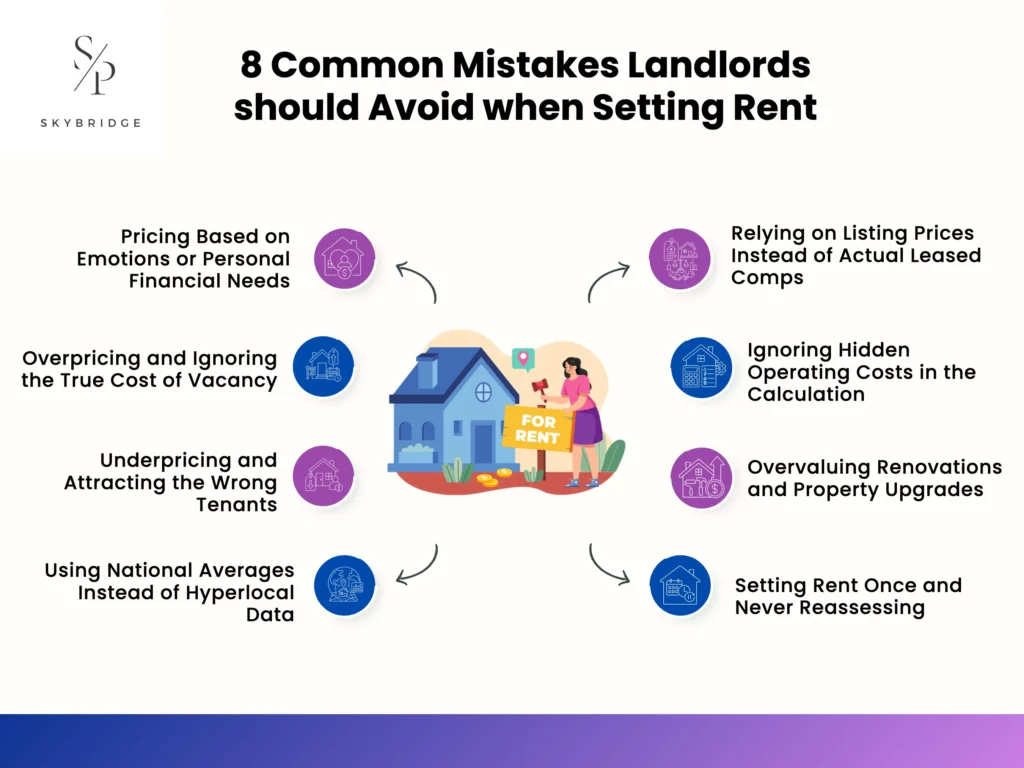
Common mistakes landlords should avoid when setting rent include setting rent based on emotions, overpricing or underpricing, relying on broad market averages, ignoring leased comparables and operating costs, overvaluing upgrades, and failing to reassess rent regularly. Making informed, market-based pricing decisions helps attract qualified tenants, reduce vacancy periods, maintain profitability, and keep your rental competitive over the long term.
8 common mistakes landlords should avoid when setting rent are:
- Pricing Based on Emotions or Personal Financial Needs
Your rental price should reflect market value, not personal financial goals or emotional attachment to the property. Base your rent on comparable rentals, location, and property features instead of your mortgage payment or desired income. Market-driven pricing attracts more qualified tenants and improves long-term occupancy.
- Overpricing and Ignoring the True Cost of Vacancy
Setting rent too high can leave your property vacant longer than expected. Every vacant day reduces rental income and may offset any additional rent you hoped to earn. Compare recently leased properties and choose a competitive price that balances occupancy with long-term profitability.
- Underpricing and Attracting the Wrong Tenants
Offering rent below market value is not always the fastest path to a successful lease. While lower pricing may increase inquiries, it can reduce returns and attract applicants who do not meet your desired qualifications. Price your property according to its true market value.
- Using National Averages Instead of Hyperlocal Data
Rental prices should be based on your immediate market rather than broad national or statewide averages. Demand, neighborhood amenities, school districts, and local competition vary widely, even within the same city. Use hyperlocal comparable rentals to establish a realistic and competitive rental price.
- Relying on Listing Prices Instead of Actual Leased Comps
Active rental listings do not always represent the amount tenants ultimately agree to pay. Review recently leased comparable properties instead of relying solely on advertised prices. Actual lease data provides a more accurate benchmark for setting a competitive rental rate.
- Ignoring Hidden Operating Costs in the Calculation
Every rental price should account for the recurring costs of owning and maintaining the property. Include expenses such as property taxes, insurance, maintenance, utilities, and HOA fees when calculating rent. Factoring in these costs helps maintain positive cash flow and financial stability.
- Overvaluing Renovations and Property Upgrades
Landlords should avoid overvaluing renovations because not every upgrade justifies higher rent. Compare your improvements with similar local properties before increasing rent. High-value upgrades, such as updated kitchens, renovated bathrooms, and energy-efficient features, are more likely to support higher rental pricing than cosmetic improvements alone.
- Setting Rent Once and Never Reassessing
Rental pricing should be reviewed regularly instead of remaining unchanged year after year. Monitor comparable rentals, local demand, operating costs, and neighborhood trends before each lease renewal or new tenancy. Regular adjustments help keep your property competitive and aligned with current market conditions.
How Can Landlords Maximize Their Rental Income?
Landlords can maximize their rental income by using accurate pricing tools, monitoring listing performance, making strategic property improvements, adding additional income opportunities, listing during peak rental seasons, minimizing vacancy, and encouraging lease renewals. Applying these strategies helps increase occupancy, improve cash flow, and strengthen your property’s long-term earning potential while remaining competitive in the rental market.
7 key considerations landlords can use to maximize their rental income are:
- Use Online Rent Estimate Tools
Landlords can maximize rental income by using online rent estimate tools such as Zillow Rent Zestimate and Rentometer to compare similar properties and estimate competitive rental prices. These tools provide a useful starting point but should always be verified with local market research and recently leased comparable properties.
- Monitor Your Listing Performance Early
Monitoring your rental listing early helps identify whether pricing and marketing strategies are attracting qualified tenants. Tracking listing views, inquiries, and application rates allows you to make timely adjustments that reduce vacancy and optimize rental pricing based on real-time market feedback.
- Make Cost-Effective Upgrades
Making strategic, cost-effective upgrades can increase the property’s appeal without requiring a major renovation budget. Improvements such as fresh paint, updated fixtures, and landscaping often provide a strong return on investment and can help justify higher rental pricing.
- Add Ancillary Income Streams
Optional services such as parking spaces, pet rent, laundry facilities, and storage units can increase your total rental income beyond the monthly rent. Offering these amenities in line with tenant demand and local regulations creates additional revenue while enhancing your property’s overall appeal.
- List During Peak Rental Season
Listing your property during Southern California’s peak rental season can improve visibility and tenant demand. Late spring through summer is generally the busiest leasing period, making it an ideal time to secure qualified tenants more quickly.
- Price to Minimize Vacancy
Setting a competitive rental price helps minimize vacancy and maintain consistent rental income. Instead of holding out for the highest possible rent, use local comparable rentals and vacancy trends to balance profitability with faster occupancy.
- Offer Lease Renewal Incentives
Encouraging existing tenants to renew their leases can improve long-term rental income and reduce turnover costs. Renewal incentives such as moderate rent increases, flexible lease terms, or small renewal discounts often increase tenant retention while minimizing vacancy periods.