
A typical late rent fee is calculated as a percentage of the monthly rent, typically 2% to 12%, with 5% commonly used as a practical benchmark. Rent is considered late when a tenant fails to pay by the due date specified in the lease, typically the first of the month, after any agreed-upon grace period, generally 2 to 5 days. Grace periods vary by state, as Texas requires 2 days, North Carolina requires 5 days, and some states, like Florida and Georgia, may allow fees immediately if outlined in the lease.
Additionally, late rent fees must be clearly stated in the lease, reasonable, and reflect administrative costs without being punitive. State laws also influence fee limits, with Texas capping fees based on property size at 10-12% and Washington capping them at 10%. In California, there is no statutory limit, meaning landlords often follow general guidance suggesting a 5-10% range as reasonable. Clearly defining due dates, grace periods, and fee amounts in the lease helps landlords enforce fees and pursue legal remedies if necessary.
When Is Rent Considered Late?
Rent is considered late when the tenant fails to pay by the due date specified in the lease agreement, generally the 1st of the month, after any agreed-upon grace period has expired. Most leases allow a 3 to 7-day grace period to accommodate common delays, such as bank processing or mail delivery. For example, if rent is due on the 1st with a 5-day grace period, it becomes officially late on the 6th.
Landlords generally determine lateness based on when payment is received, rather than when it is sent, and some lease agreements may adjust deadlines if the due date falls on a weekend or holiday. Additionally, late rent is applied in accordance with the lease terms, but must comply with state or local regulations, which may cap the fee or define a minimum grace period. Persistent late payments can result in late fees, formal notices, and, ultimately, eviction proceedings.
How Long Is a Grace Period to Pay Rent?
A rent grace period typically lasts 2 to 5 days after the rent due date, allowing tenants to pay without incurring late fees. While commonly included in leases, grace periods are not legally required in all states, and their duration varies depending on local regulations. For example, Texas Property Code § 92.019 mandates a 2-day grace period, whereas North Carolina (NC Gen. Stat. § 42-46) requires 5 days. Rent becomes officially late the day after the grace period ends, at which point landlords can apply late fees.
On the other hand, in states without a mandatory grace period, such as Florida or Georgia, landlords may legally charge a late fee the very next day, provided the lease explicitly outlines this policy. Despite these variations, a 5-day grace period has become the industry standard, balancing tenant convenience with landlord protection.
When Can Landlords Charge Late Fees?
Landlords can legally charge late fees after the rent due date once any agreed-upon grace period has expired, typically 2 to 5 days as specified in the written lease agreement. To be enforceable, the late fee policy must be clearly outlined in the lease, ensuring landlords can legally collect the fee. Fees must also be reasonable and non-punitive, reflecting actual costs or, in many cases, not exceeding a certain percentage of the monthly rent, commonly around 5%. By clearly specifying the due date, grace period, fee amount, and adherence to state laws, landlords protect their right to assess late fees while minimizing disputes and legal challenges.
How Much Can a Landlord Charge for Late Rent?
For late rent, landlords generally set 2% to 12% of the monthly rent, while exact amounts vary by lease and jurisdiction. Many landlords use 5% as a practical benchmark because it is high enough to encourage timely payment but low enough to be viewed as reasonable rather than punitive. For instance, for a $2,000-per-month property, a fee of $100 to $200 is generally defensible in court as a reasonable estimate of the administrative costs and liquidated damages incurred by the landlord.
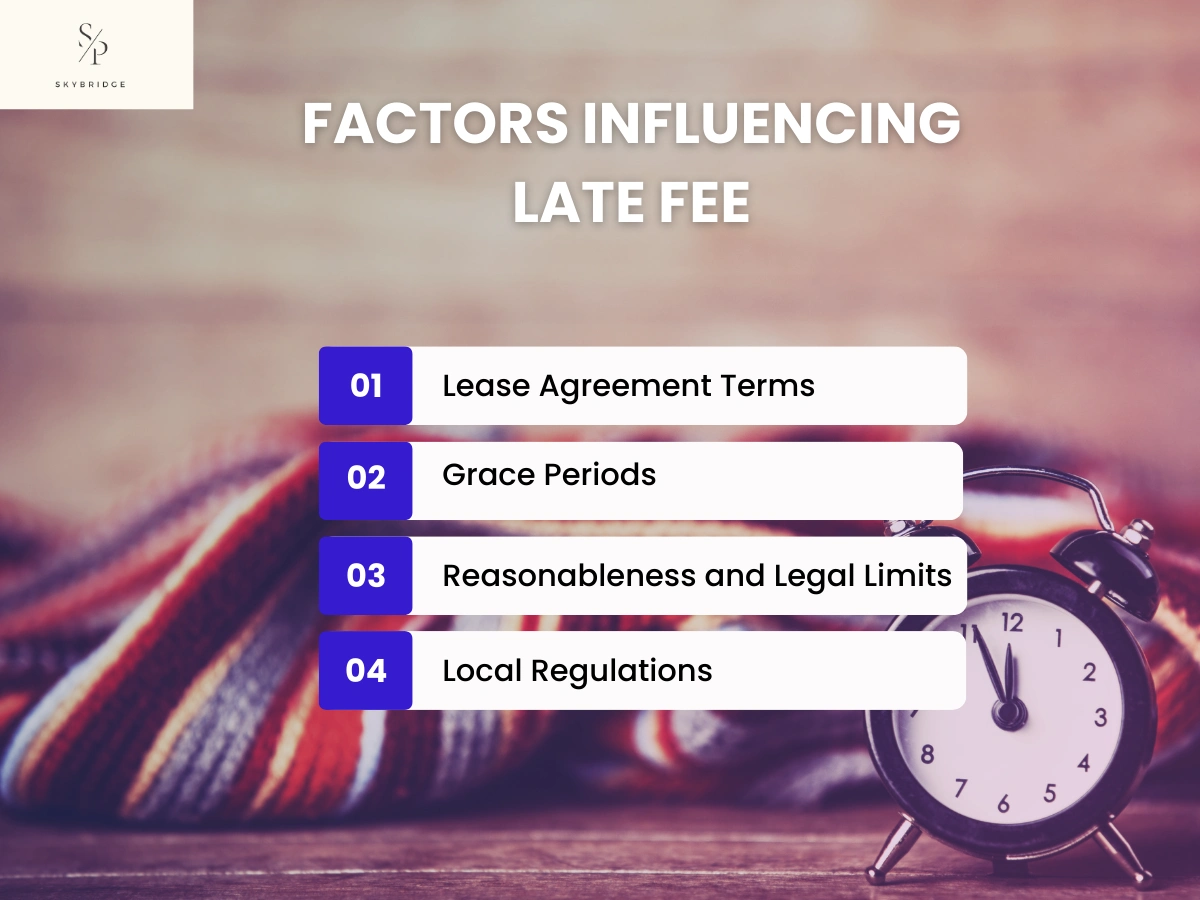
Several key factors influencing how much a landlord can charge include:
- Lease Agreement Terms: The fee must be clearly defined in writing in the lease or rental agreement, either as a flat amount or as a percentage of monthly rent. Without this written provision, late fees may not be enforceable.
- Grace Periods: Because fees are typically assessed only after the lease’s grace period expires (often 2-5 days), landlords should align the fee calculation with the lease’s defined timeline.
- Reasonableness and Legal Limits: Many state and local laws require that late rent fees be reasonable, meaning they reflect administrative costs or losses associated with late rent, not punitive penalties. In some cases, statutes expressly cap late fees at a percentage of the rent (for example, 5% of monthly rent), while in others, courts may review whether a fee is reasonable based on actual costs.
- Local Regulations: Certain jurisdictions limit the amount or structure of late fees or specify minimum grace periods before fees can be charged. Landlords must ensure compliance with local landlord‑tenant laws and the lease terms.
Does Late Fees for Rent Vary by State?
Yes, late rent fees vary significantly by state because they are governed by state-specific landlord-tenant laws regarding maximum allowable fees and required grace periods. Some states, including New York and Texas, have specific caps or percentage limits (generally 5-10%) on how much landlords can charge, while other states, including California, impose no statutory limit. Requirements such as grace periods, fee structures (percentage vs. flat amount), and statutory limits vary by jurisdiction, so landlords must align their late‑fee policies with both state law and their lease agreements to ensure compliance and enforceability.
Here is a table highlighting maximum late fees according to different states:
| State | Maximum Late Fee |
| California | No limit |
| Arizona | No limit, but mobile homes are limited to $5/day |
| Delaware | 5% of monthly rent |
| Georgia | No limit |
| Florida | No limit |
| Maryland | 5% of monthly rent |
| New York | 5% of the monthly rent or $50/day |
| North Carolina | 5% or $4 for week-to-week leases |
| Texas | 10-12% of the monthly rent |
| Virginia | 10% of monthly rent |
How Much Is the Maximum Late Fee for Rent in California?
California law does not set a specific maximum dollar amount for late rent fees, but all fees must be reasonable and reflect the landlord’s actual costs. Under California Civil Code Section 1671, excessive or punitive fees are unlawful, so landlords must ensure that late fees cover administrative or other documented costs associated with processing late rent.
A common standard is a 5% fee of the monthly rent, which is widely considered reasonable, while fees up to 10% may be challenged if they do not reflect actual costs. For the late fee to be enforceable, it must be explicitly stated in the written lease agreement. While not strictly required by state law, many landlords provide a 3- to 5-day grace period before applying late fees, helping reduce disputes and encourage timely payment.
How Much Is the Maximum Late Fee for Rent in Texas?
In Texas, the maximum late fee a landlord can charge depends on the size of the property, with 12% of the monthly rent for buildings with four or fewer units and up to 10% for larger properties. Late fees must be clearly stated in the written lease and cannot be applied until rent is at least two full days late. For example, if rent is due on the 1st, the fee cannot be charged until the 4th. Fees must also be reasonable, reflecting the actual costs the landlord incurs in collecting late rent, as excessive or punitive fees may be illegal. For instance, on a $1,500 monthly rent, a 12% fee would amount to a maximum of $180.
How Much Is the Maximum Late Fee for Rent in Arizona?
Arizona does not impose a general statewide late-fee cap for most rental properties. Instead, late fees must be reasonable and explicitly stated in the lease or rental agreement. While no fixed cap exists, fees exceeding 10-15% of the monthly rent are often considered potentially excessive by courts. An exception applies to mobile home spaces, where the statute limits late penalties to no more than $5 per day starting after the sixth day past due. By clearly defining late fees in the lease and ensuring they are reasonable, landlords can enforce fees effectively while minimizing legal risks.
How Much Is the Maximum Late Fee for Rent in Florida?
In Florida, there is no specific statutory maximum for late fees on standard residential rentals, but all fees must be reasonable and explicitly stated in the lease agreement. Landlords commonly charge $20 or 20% of the rent due, whichever is greater, to cover administrative costs and reflect standard practice. New 2026 legislation (HB 811) now requires landlords to wait 5 days (excluding weekends and holidays) after delivering written notice before imposing late-related surcharges or terminating a lease. If a fee is deemed unconscionable or punitive by a court, it may not be enforceable.
How Much Is the Maximum Late Fee for Rent in Georgia?
Georgia does not set a statutory maximum for late fees on residential rentals, but fees must be reasonable and explicitly stated in the lease agreement to be enforceable. There is no required grace period under state law, allowing landlords to apply fees once rent is late according to the lease terms. For residential properties, keeping late fees within the 5-10% range of monthly rent is generally considered reasonable and defensible in local courts.
While there is no statutory cap, Georgia Code § 10-4-217 provides exceptions for commercial or self-storage units, allowing the greater of $20 or 20% of the rent due. Clearly defining late fees and any applicable grace period in the lease ensures landlords can collect fees legally while minimizing disputes.
How Much Is the Maximum Late Fee for Rent in Washington?
In Washington, the maximum late fee for residential rent is capped at 10% of the monthly rent, effective 2026, following stricter rent stabilization and fee limits. While state law previously considered $20 or 20% reasonable in some contexts, new residential regulations now prioritize the 10% cap for most fees. Although there is no specific statutory grace period for the fee itself, landlords must provide tenants with a 14-day notice to pay or vacate before initiating eviction proceedings. Clearly defining the late fee and complying with the lease’s notice requirements help ensure landlords remain compliant while protecting their right to collect overdue rent.
When Can a Landlord Legally Evict a Tenant for Late Payment of Rent?
A landlord can legally evict a tenant for late rent once the tenant has failed to pay according to the lease agreement and any applicable grace period has expired. The eviction process typically follows several key steps, including serving a 3-Day Notice to Pay, issuing a formal written notice, and filing an unlawful detainer case. Carefully following each step ensures landlords remain compliant with state and local laws while minimizing the risk of disputes or procedural errors.
The legal eviction workflow the landlord must follow includes:
- Serve 3 Day Notice To Pay: The landlord must provide a written 3-day notice to pay overdue rent or face eviction. It alerts the tenant that nonpayment violates the lease. If the notice is mailed, the tenant has two additional days to pay.
- Formal Written Notice: To be legally binding, the notice cannot be a text message or a phone call, it must be a formal written notice written by the landlord that includes the tenant’s name, the total amount due, the property address, and a clear statement that failure to comply will lead to legal action.
- File Unlawful Detainer Case: If the notice period expires and the tenant has neither paid nor moved out, the landlord must file a summons and complaint for an Unlawful Detainer. This is a specialized lawsuit designed to recover possession of real property from a tenant who is unlawfully detaining it.
- Serve the Tenant: Once the case is filed, you must serve the tenant with the court summons and complaint. This must typically be done by a professional process server or a neutral third party (not the landlord) to ensure the tenant is legally notified of the lawsuit and their right to respond.
- Court Hearing: The final stage is the court hearing, where both the landlord and tenant appear before a judge. As the landlord, you must provide the written lease agreement, proof of the unpaid rent, and evidence that all notices were served correctly. If the judge rules in your favor, they will issue a judgment for possession, allowing local law enforcement to remove the tenant.
How Can Landlords Avoid and Handle Late Rent?
Landlords can avoid and handle late rent by screening tenants carefully, automating rent reminders, reviewing lease agreements, offering payment discounts, and setting flexible due dates. Implementing these strategies helps landlords maintain consistent cash flow, reduce disputes, and ensure that rent payments are collected on time. By combining careful tenant selection, clear lease terms, and timely communication, landlords can create a more predictable and manageable rental income process.
Strategies landlords can use to avoid and handle late rent are:
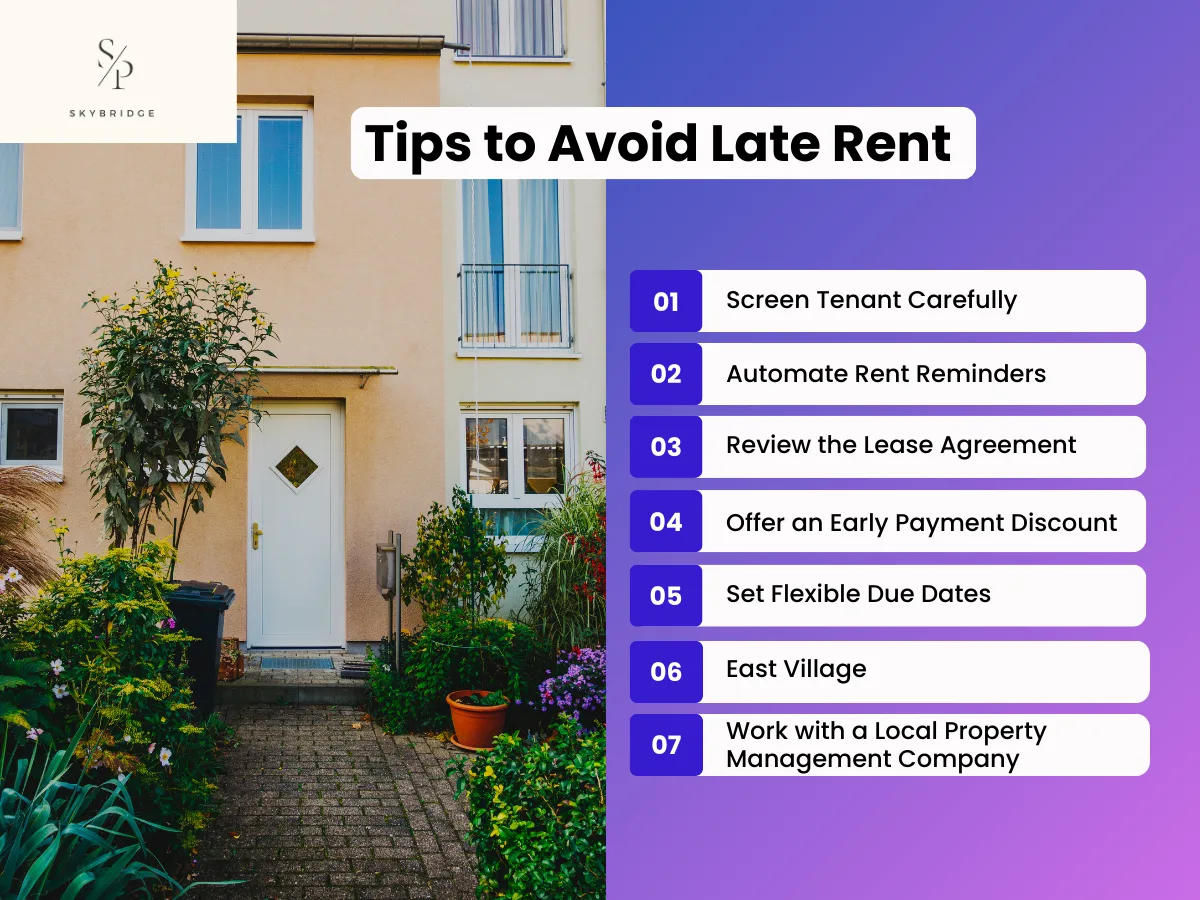
- Screen Tenant Carefully: Conduct thorough background checks, including credit scores, income verification (typically 3× the monthly rent), and rental references. Selecting tenants with a history of on-time payments significantly reduces the likelihood of late rent.
- Automate Rent Reminders: Use property management software to send rent reminders via email or SMS three days before the due date and on the due date itself, which can significantly increase on-time payments with minimal manual effort.
- Review the Lease Agreement: Ensure it explicitly states the rent due date, the grace period (typically 3-5 days), and the specific late fee amounts. Clearly defining these terms in the lease not only provides tenants with transparency about their obligations but also gives landlords legal backing to enforce timely payments.
- Offer an Early Payment Discount: Offering a small discount, such as $20 for payment 48 hours early, can motivate tenants to prioritize your rent over other bills. Psychological rewards often encourage timely payments more effectively than penalties.
- Set Flexible Due Dates: Standard leases set the 1st as the due date, but this may not align with a tenant’s pay cycle. Setting flexible due dates that correspond with a tenant’s bi-weekly or monthly paycheck can drastically reduce the likelihood of NSF (non-sufficient funds) issues.
- Work with a Local Property Management Company: If the stress of collection becomes a burden, the most effective solution is to partner with a professional property management company. A property management company acts as a buffer between you and the tenant, handling everything from automated collections and legal notices to high-level tenant relations, ensuring your investment remains passive.