

To market multifamily properties effectively, optimize the property website, leverage social media platforms, upgrade property features, use virtual leasing tools, run targeted advertising campaigns, and manage online reputation to remain competitive in the rental market. These marketing activities help apartment communities reach renters at different stages of the apartment search process and create multiple opportunities for prospects to discover and evaluate the property.
When these strategies are supported by a clear marketing plan, consistent branding, and ongoing performance tracking, they become more effective at generating qualified leasing inquiries. A structured multifamily marketing approach not only improves renter engagement but also helps properties strengthen brand recognition, maintain stable occupancy levels, and support long-term rental revenue.
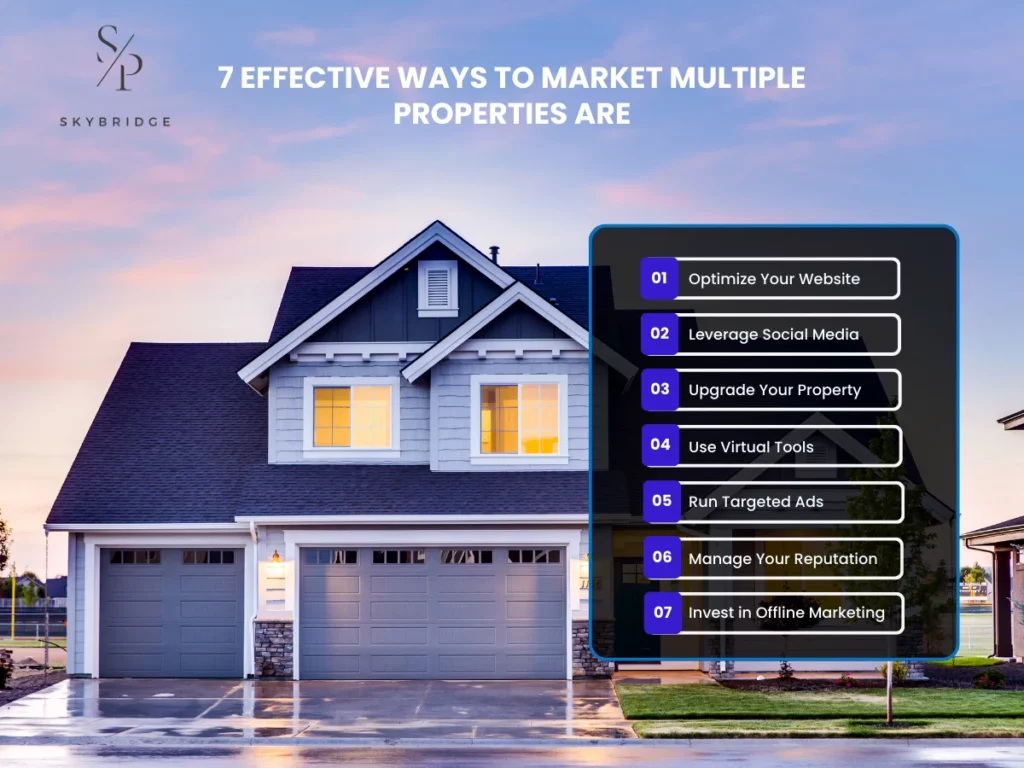
7 effective ways to market multiple properties are:
- Optimize Your Website
- Leverage Social Media
- Upgrade Your Property
- Use Virtual Tools
- Run Targeted Ads
- Manage Your Reputation
- Invest in Offline Marketing
Optimize Your Website
A property website acts as the central hub for multifamily digital marketing and online leasing, often functioning as a 24/7 digital leasing office. Many renters first discover an apartment community through search engines or listing platforms, so the website must load quickly, work seamlessly on mobile devices, and guide visitors toward leasing actions. Integrating Property Management Software (PMS) helps display real-time unit availability and pricing, while clear calls to action, such as “Schedule a Tour” or “Apply Now,” move prospects smoothly through the leasing journey.
Here is how to optimize your multifamily property website for better results:
- Improve page speed and mobile responsiveness to help renters browse listings easily on phones and tablets.
- Integrate PMS or leasing software to display real-time availability, pricing, and online applications.
- Use high-quality photos and interactive floor plans to help renters visualize apartment layouts and amenities.
- Add clear calls to action, such as tour scheduling, contact forms, and online applications, to capture leads.
- Track website analytics, including traffic, conversion rates, and cost per lead, to refine multifamily marketing strategies.
Leverage Social Media
Social media platforms allow property managers to promote multifamily properties and engage prospective renters through dynamic visual content and real-time community updates. Platforms such as Instagram and Facebook help apartment communities showcase high-end interiors, resident events, and neighborhood highlights that illustrate daily life at the property. This digital presence is more vital than ever, as data from Multi-Housing New shows that 80% of apartment seekers now use social media to narrow down their housing choices or “vibe check” a community before ever scheduling a tour.
Paid social campaigns across social media further amplify this reach by allowing property managers to target renters based on precise location, interests, and housing behavior. These sophisticated campaigns can reach users who have recently searched for “apartments near me” or who fall within a specific demographic profile. Beyond simple advertising, active social media communication strengthens community leasing by allowing property managers to respond directly to renter questions, humanizing the brand, and building the foundational trust necessary for a prospective resident to sign a lease.
Upgrade Your Property
Renovated interiors and updated shared spaces create powerful marketing hooks that allow a property to command higher rents and stand out in competitive urban markets. Communities that invest in maintaining a modern living environment see a significant uptick in organic interest and stronger leasing activity, as the physical product finally matches the high-quality digital marketing. This strategy remains a top priority for investors, as value-add multifamily strategies targeting property improvements deliver healthy internal rates of return (IRR) between 11% and 16%, outperforming standard core investments (Source: BAM Capital).
Common high-impact upgrades include stainless steel appliances, luxury vinyl plank flooring, designer lighting, and smart-home features such as Nest thermostats and keyless entry. Furthermore, community improvements such as state-of-the-art fitness centers, coworking lounges, and outdoor oases heavily influence modern renters’ decisions. By highlighting these specific upgrades in marketing materials, property managers effectively communicate the property’s value proposition and attract a more qualified, long-term tenant base.
Use Virtual Tools
Virtual tools such as 3D Matterport tours and virtual staging allow prospective renters to explore apartment communities remotely, making multifamily marketing more accessible and flexible. These tools enable renters to take a digital walkthrough at any time, keeping properties accessible to busy professionals and out-of-town prospects who cannot visit in person. Their impact on leasing performance can be substantial. According to data from LCP Media, properties offering both property-level and unit-level virtual tours can reduce average vacancy periods by up to 5 days, helping minimize annual vacancy losses.
Virtual engagement becomes even more effective when paired with AI-powered chatbots, video walkthroughs, interactive floor plans, and digital leasing platforms. Chatbots answer common questions about amenities, parking, and pet policies while guiding prospects through the leasing process. At the same time, tools such as online applications, document uploads, and electronic lease signing streamline the leasing workflow, allowing renters to evaluate units, submit applications, and complete the leasing process more efficiently.
Run Targeted Ads
Targeted advertising helps multifamily properties reach renters who actively search for apartments in specific locations. Search engine marketing (SEM) campaigns on platforms such as Google Ads allow property managers to appear in search results for high-intent searches like “apartments for rent in [city]” or “two-bedroom apartments near downtown.” Paid social media advertising on platforms like Facebook and Instagram complements search ads by promoting property visuals, floor plans, and leasing offers directly to renters based on location, interests, and housing behavior.
Advanced strategies such as geofencing and retargeting improve campaign precision. Geofencing allows marketers to serve ads to individuals visiting nearby universities, business districts, or competing apartment communities, while retargeting reconnects with users who visited a property website but did not schedule a tour. Property managers monitor metrics such as cost per lead (CPL), click-through rate (CTR), and lead-to-lease conversions to evaluate campaign performance and optimize advertising efficiency.
Manage Your Reputation
Online reputation strongly influences multifamily marketing performance because renters frequently rely on resident reviews and property ratings when evaluating apartment communities. Platforms such as Google Reviews, Yelp, and apartment listing websites provide insight into maintenance quality, leasing staff communication, and overall resident satisfaction. A property that maintains strong ratings often receives more leasing inquiries because renters interpret positive feedback as evidence of reliable management.
Effective reputation management requires property managers to monitor reviews, respond to feedback, and encourage satisfied residents to share their experiences online. Responding to both positive and negative reviews promptly demonstrates attentiveness and professionalism. Many communities also implement structured review-generation strategies by requesting feedback after successful maintenance requests or resident events, thereby maintaining a steady stream of authentic reviews and strengthening the property’s digital credibility.
Invest in Offline Marketing
Although digital channels drive much of modern multifamily marketing, localized offline marketing helps strengthen neighborhood visibility and community recognition. High-visibility signage, professional leasing banners, and clear directional signs introduce your property to commuters and pedestrians who pass through the area daily. These physical marketing elements establish a strong on-the-ground presence and often generate valuable walk-in inquiries from renters who already prefer the surrounding neighborhood.
Offline strategies also benefit from local partnerships and community engagement. Collaborating with nearby businesses, such as coffee shops, restaurants, and fitness studios, to offer resident discounts creates a neighborhood ecosystem that enhances the property’s lifestyle value. Hosting open house events and distributing professionally designed brochures through local organizations further reinforces awareness, ensuring the community becomes a recognizable and trusted part of the local area.
How to Create a Multifamily Marketing Plan?
To create a multifamily marketing plan, start by defining your target audience, setting an appropriate marketing budget, choosing your channels, building a content plan, and monitoring them effectively. These steps help property managers organize their marketing efforts to consistently attract qualified renters and maintain visibility across search engines, social media, and listing platforms.
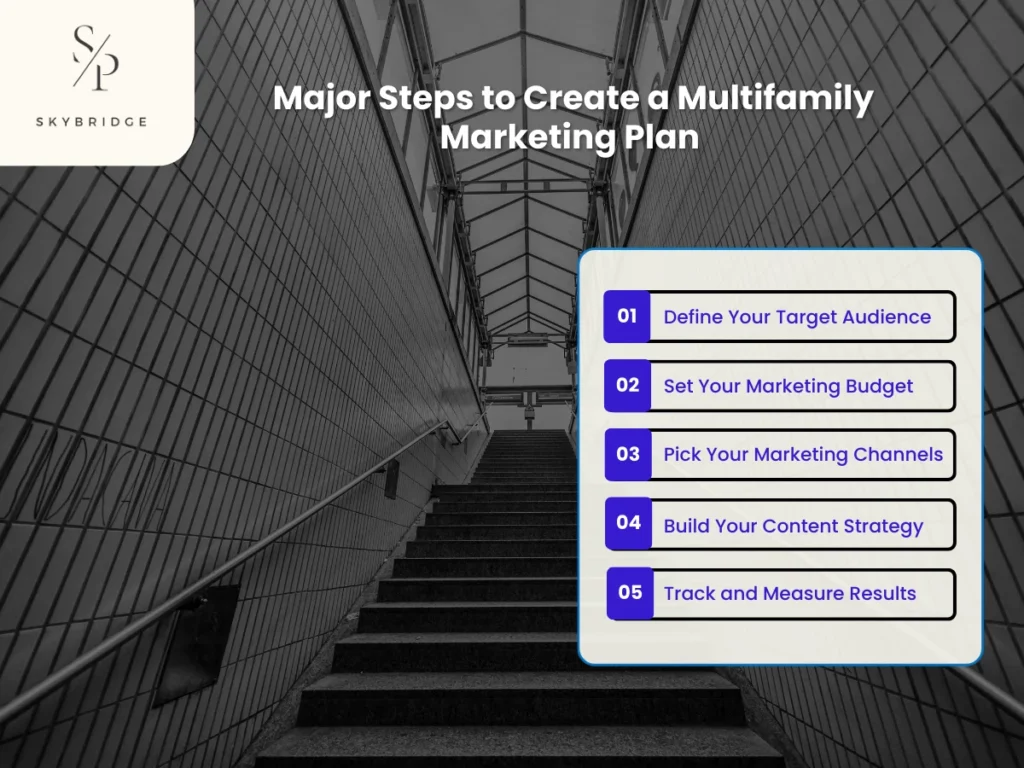
Below are the 5 major steps to create a multifamily marketing plan:
- Define Your Target Audience
Every multifamily marketing plan begins with identifying the ideal renter profile and clear marketing goals. Property managers create renter personas using demographics such as age and income, psychographics such as lifestyle preferences and values, and digital behavior such as preferred platforms and apartment-search patterns. For example, a property near a university may target graduate students and faculty, while a suburban community may focus on young families or remote professionals.
At this stage, it is also important to define the property’s unique selling proposition (USP), which highlights what differentiates the community, such as premium amenities, a prime location, or a strong neighborhood atmosphere. Clear audience targeting and defined goals help guide messaging, marketing channels, and leasing strategies that attract qualified renters. - Set Your Marketing Budget
Setting a multifamily budget is a balance between maintaining stabilized occupancy and aggressive growth during lease-ups. According to the Gartner CMO Spend Survey, a common industry benchmark for 2026 is allocating roughly 7.7% to 10% of gross revenue to marketing, though new developments may require up to 20% to gain initial market share.
Budgets should be divided between fixed costs and variable marketing expenses. Fixed costs may include website hosting, marketing software, and listing platform subscriptions, while variable expenses often cover pay-per-click advertising, social media campaigns, and content production. Many property managers also reserve a small experimentation budget to test emerging opportunities such as AI-driven search tools or local influencer collaborations. - Pick Your Marketing Channels
In an era of fragmented media, your property needs to be present where renter intent actually exists. Rather than spreading resources across too many platforms, successful multifamily marketing strategies often focus on 3 to 4 primary channels that align with renters’ behavior and search intent.
For example, search engine optimization (SEO) supports long-term visibility in apartment searches, while Google Ads helps capture renters actively searching for apartments in a specific city. Social platforms such as Instagram or TikTok allow properties to showcase community lifestyle through visual storytelling. Localized strategies, such as geofencing competitors or nearby landmarks, can also strengthen neighborhood visibility. - Build Your Content Strategy
A strong content strategy helps communicate the property’s value by highlighting the lifestyle, amenities, and neighborhood experience renters can expect. High-quality photos, apartment walkthrough videos, amenity highlights, and neighborhood guides help prospects visualize daily life before scheduling a tour. These visual assets improve engagement across property websites, listing platforms, and social media channels where renters often compare multiple communities.
Consistent content across property websites, social media platforms, and listing directories also strengthens brand recognition. Many property managers create content calendars that include resident events, leasing promotions, and property updates to maintain consistent visibility and reinforce the community brand. - Track and Measure Results
Tracking marketing performance helps property managers identify which campaigns generate qualified renter leads and leasing activity. Key metrics include website traffic, cost per lead (CPL), click-through rates (CTR), and lead-to-lease conversion rates. These insights reveal how renters discover the property and which marketing channels drive the most leasing inquiries.
Regular performance analysis allows marketing teams to refine campaigns and improve efficiency. By reviewing campaign data, property managers can adjust advertising budgets, improve targeting, and strengthen messaging. Continuous monitoring ensures multifamily marketing strategies remain data-driven and adaptable, helping properties maintain strong occupancy and respond to changing renter demand.
How to Budget for Multifamily Marketing?
Budgeting for multifamily marketing begins by reviewing past performance, allocating funds across effective channels, segmenting budgets by property type, separating brand and sales spending, and tracking overall marketing expenses. A structured budget ensures marketing investments support occupancy goals while maintaining consistent visibility across renter discovery platforms.
The following 5 steps help property managers allocate resources strategically and maintain efficient marketing operations.
- Review Past Performance
Start by auditing the previous year’s marketing data to determine which channels generated qualified renter leads. Analyze metrics such as cost per lead (CPL) and lead-to-lease conversion rates across listing platforms, paid ads, and organic channels. If a source generated high traffic but few move-ins, consider reallocating those funds. Reviewing historical performance also helps identify seasonal leasing trends and set realistic marketing benchmarks for the upcoming year. - Allocate by Channel
Distribute the marketing budget across a mix of organic, paid, and social channels based on their role in the renter journey. SEO and content marketing support long-term visibility, while PPC advertising and geofencing deliver immediate exposure when vacancy increases. A balanced budget often prioritizes digital channels while still reserving funds for reputation management and local offline marketing to maintain strong visibility across renter touchpoints. - Segment by Property Type
Marketing needs vary drastically depending on the asset’s lifecycle and class. A Class A luxury lease-up requires a massive upfront launch budget to build awareness and meet aggressive move-in targets, often accounting for 20% of projected revenue. Conversely, a stabilized Class B property may require only a 5% to 8% maintenance budget to offset natural turnover. Tailoring your financial commitment to the specific property type ensures that you are not overspending on high-occupancy assets or underfunding communities that desperately need a competitive edge. - Split Brand and Sales Budget
Distinguish between long-term brand equity and short-term sales activation to ensure holistic growth. Your brand budget covers top-of-funnel efforts, such as high-end videography, community lifestyle branding, and reputation-building, which establish trust over time. The sales budget focuses on bottom-of-funnel tactics such as Google Ads and lead-generation tools to fill immediate vacancies. Balancing these two ensures that while you close leases today, you also build the desirability and name recognition that will make future leasing efforts easier and more cost-effective. - Track Marketing Spend
Tracking marketing expenses ensures that budgets remain aligned with performance goals. Property managers monitor spending alongside metrics such as cost per lead, campaign reach, and lease conversions to determine whether marketing investments produce acceptable returns. Continuous tracking allows teams to adjust budgets, shift resources to high-performing channels, and maintain efficient marketing operations.
What Are the Common Multifamily Marketing Mistakes to Avoid?
Common multifamily marketing mistakes to avoid include using low-quality visuals, neglecting digital presence, and targeting the wrong audience. These issues can reduce renter engagement, weaken online visibility, and waste marketing budgets on unqualified leads. Recognizing and correcting these mistakes helps property managers improve marketing performance and attract renters more likely to convert into long-term tenants.
3 common multifamily marketing mistakes to avoid are:
- Using Low-Quality Visuals
In multifamily marketing, first impressions are largely visual, and grainy, poorly lit, or outdated photos can signal a lack of professionalism, discouraging prospects from exploring the property further. Since most renters evaluate apartment communities online before scheduling a tour, weak visuals can significantly reduce listing engagement and inquiries.
Research by VHT Studios shows that listings with professional photography receive 118% more views, and properties with high-quality images can see up to a 32% increase in closing rates. Instead of relying on smartphone photos, property managers should invest in professional photography and enhance listings with 3D tours, drone footage, and well-lit images of amenities to convey a stronger sense of lifestyle. - Neglecting Digital Presence
Many property managers treat their digital presence as a one-time setup rather than an ongoing marketing effort, which can harm visibility and renter trust. Outdated websites, incorrect pricing information, broken links, or inactive social media accounts often push prospects toward competing communities with more reliable online information.
Maintaining a strong digital presence requires consistent updates, including regularly refreshing unit availability, posting social media content, and reviewing listings on platforms such as Zillow and Google Business Profiles to ensure accuracy. An active and well-maintained digital presence improves search visibility, strengthens credibility, and keeps the property competitive in online apartment searches. - Targeting the Wrong Audience
Targeting the wrong audience is one of the most expensive mistakes in multifamily marketing because it generates traffic without qualified leasing leads. For example, advertising luxury apartment amenities to renters searching for budget housing may attract website visitors but rarely results in signed leases, increasing the cost per acquisition (CPA).
To improve campaign performance, property managers should develop data-driven renter personas that reflect income levels, lifestyle preferences, and housing priorities. Marketing messages, advertising platforms, and geofencing strategies can then be tailored to reach renters more likely to convert, resulting in higher-quality leads and more efficient marketing spend.
What Are the Benefits of Multifamily Property Marketing?
The benefits of multifamily property marketing include higher occupancy rates, more qualified tenants, stronger brand recognition, improved resident retention, and more stable revenue performance. As the rental market becomes more competitive and renters rely heavily on digital research before choosing a home, effective marketing helps properties remain visible, communicate their value, and consistently generate leasing demand.
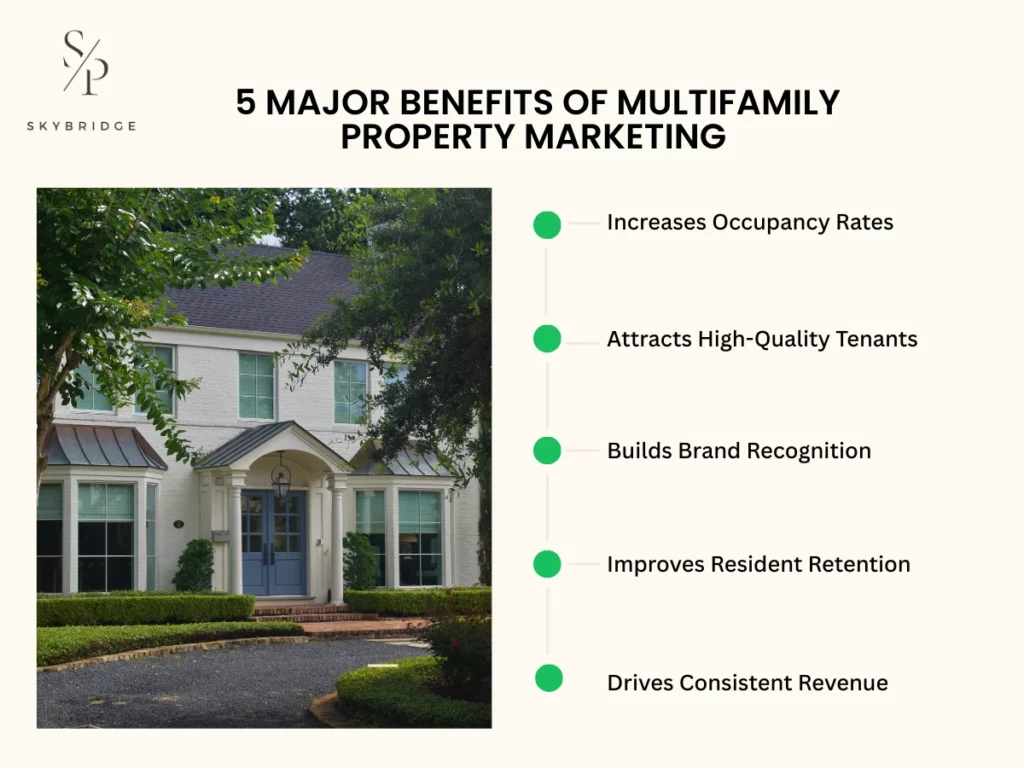
Here are 5 major benefits of multifamily property marketing:
- Increases Occupancy Rates
The rental market has become increasingly competitive as new apartment communities enter both urban and suburban areas. Without strong marketing, even well-located properties can struggle to attract renter attention. Strategic marketing through search visibility, property listings, and targeted advertising helps properties stand out and remain visible during the renter’s decision process. This consistent exposure generates more leasing inquiries and supports higher occupancy levels over time. - Attracts High-Quality Tenants
Modern renters often complete much of their research online before contacting a leasing office. According to the National Apartment Association, 79% of renters visit a property website and 70% prefer digital-first interactions, such as virtual tours and online communication. Communities that offer these tools attract well-informed renters who are more likely to meet income and credit requirements, thereby improving leasing efficiency. - Builds Brand Recognition
Consistent branding across search engines, listing platforms, and social media helps transform an apartment community from a simple housing option into a recognizable local brand. Visibility across multiple platforms increases familiarity and builds trust among prospective renters. Research from SatisFacts shows that 12.4% of renters consult social forums such as Reddit or Nextdoor when evaluating a property’s reputation. A strong brand presence reinforces credibility and allows properties to compete more effectively in crowded markets. - Improves Resident Retention
Marketing also plays a role in strengthening relationships with current residents. Regular communication, community updates, and positive engagement across digital platforms reinforce the property’s reputation and sense of community. When residents feel connected to the property’s brand and lifestyle experience, they are more likely to renew their leases. This reduces turnover and helps maintain long-term occupancy stability. - Drives Consistent Revenue
Effective marketing contributes directly to stable revenue by maintaining steady leasing activity and minimizing vacancy periods. Data-driven marketing strategies enable property managers to adjust pricing, promote available units, and respond quickly to changes in seasonal demand. With national-advertised rent growth projected to increase by 1.2% in 2026, according to the National Association of REALTORS, properties that maintain consistent marketing efforts are better positioned to capture demand and sustain revenue performance.
How to Measure Multifamily Marketing Success?
To measure multifamily marketing success, track conversion rate, monitor cost per lead, measure lead-to-lease rate, calculate cost per acquisition, and analyze overall website traffic. These metrics help property managers understand how marketing campaigns influence renter behavior, from the first online interaction to a signed lease. By regularly reviewing these indicators, marketing teams can identify high-performing channels, improve lead quality, and ensure marketing budgets contribute directly to leasing performance.
Below are 5 ways to measure multifamily marketing success:
- Track Conversion Rate
Conversion rate measures the percentage of prospects who complete a desired action during the leasing process. In multifamily marketing, this often means tracking how many leads convert into property tours and how many tours convert into signed leases. Monitoring this metric provides insight into how effectively marketing campaigns and the leasing experience guide prospects through the decision process. A strong conversion rate indicates that property messaging, visuals, and leasing communication successfully motivate renters to move forward. - Monitor Cost Per Lead
Cost per lead (CPL) measures the marketing investment required to generate each renter inquiry. The formula is total advertising spend divided by the total number of leads generated. Tracking CPL across channels such as Google Ads, social media campaigns, and listing platforms helps property managers determine which sources deliver leads most efficiently. This comparison allows marketing teams to prioritize channels that generate qualified prospects at a lower cost. - Measure Lead-to-Lease Rate
Lead-to-lease rate measures the percentage of renter inquiries that ultimately convert into signed leases. It is calculated as (Total Leases ÷ Total Leads) × 100. This metric highlights the overall quality of marketing leads and the effectiveness of the leasing process in converting prospects into residents. If the lead-to-lease rate is low, it may signal issues with lead targeting, pricing alignment, or follow-up communication. - Calculate Cost Per Acquisition
Cost per acquisition (CPA) measures the total cost required to secure a new resident. It is calculated by dividing total marketing spend by the number of new leases signed within a specific time period. This metric provides a clear picture of the cost to acquire each tenant and whether marketing investments produce a sustainable return. Understanding CPA helps property managers balance marketing expenses with expected rental revenue. - Analyze Website Traffic
Website traffic measures how many renters visit the property website and how they discover it. Property managers analyze traffic sources, including organic search, paid ads, social media referrals, and listing platforms, to understand how renters discover listings. Tools like Google Search Console, Semrush, and Ahrefs help monitor keyword rankings, search visibility, and referral traffic. These insights reveal which marketing channels drive the most prospects and where improvements can increase visibility.
Market Your Multifamily Property with a Property Management Company
Marketing your multifamily property with a professional property management team improves visibility, streamlines leasing operations, and attracts qualified tenants. A dedicated property management company uses strategies such as digital marketing, property listing optimization, targeted advertising, and reputation management to connect your property with renters actively searching for apartments. These coordinated efforts help maintain strong occupancy levels while reducing the day-to-day marketing responsibilities for property owners.
Working with an experienced property management company also provides access to market insights, leasing expertise, and data-driven marketing strategies that support long-term performance. With the right approach, property owners can strengthen brand visibility, attract reliable tenants, and maintain consistent rental income while ensuring their property remains competitive in a growing rental market.