
A rental lease agreement is a legally binding contract between a landlord and tenant that defines the terms under which a residential or commercial property is occupied for an agreed period. The agreement establishes enforceable rules for rent, lease duration, property use, maintenance responsibilities, and termination conditions, forming the legal foundation of the tenancy.
In California, rental lease agreements are highly regulated and vary by tenancy structure, including fixed-term leases, month-to-month agreements, subleases, room rentals, apartment leases, standard rental agreements, and commercial leases. These agreements determine how long a tenancy lasts, how rent may change, what disclosures are required, and how the lease may renew or end, making them the central legal document governing compliance throughout the landlord–tenant relationship.
What Are the Types of Rental Lease Agreements?
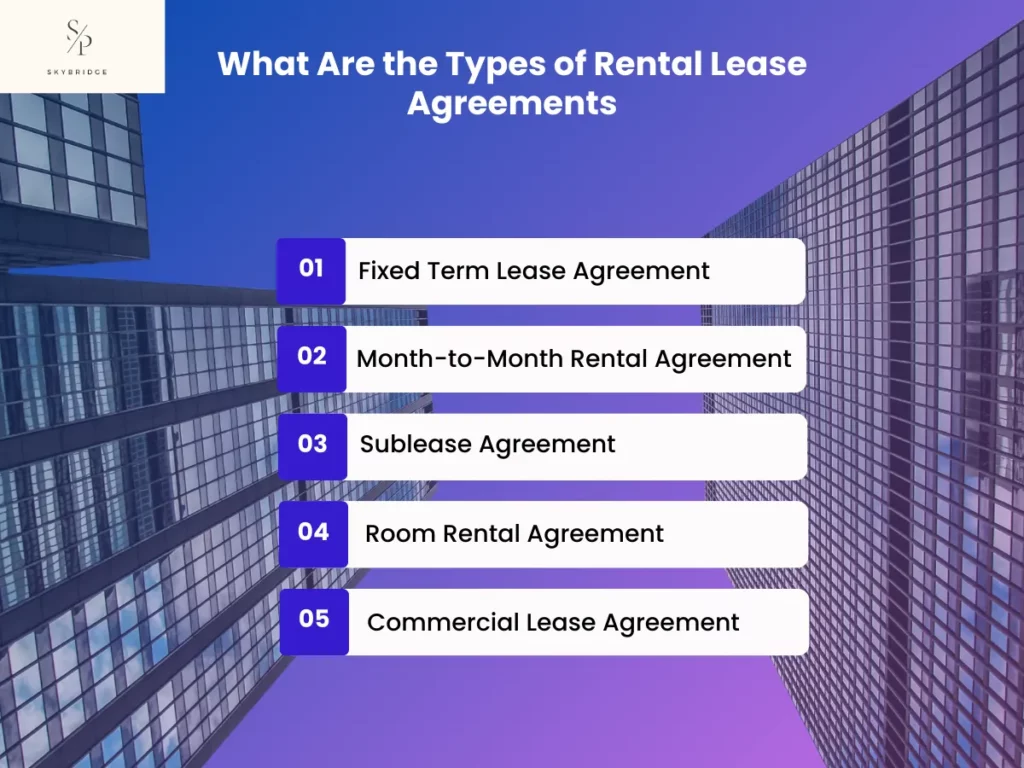
Different types of rental lease agreements include fixed-term leases, month-to-month leases, subleases, room rentals, and commercial leases. These agreements are classified by tenancy length, property type, and the legal relationship between the landlord and the occupant. In California, selecting the correct lease type is critical because state laws and local ordinances apply different rules for rent control, termination rights, and renewal requirements depending on whether a tenancy is fixed-term, periodic, shared, or commercial.
5 types of rental lease agreements include:
Fixed Term Lease Agreement
A fixed-term lease agreement, also commonly referred to as a long-term lease, is a legally binding contract that secures a rental property for a specific, predetermined period, typically 6 months to 1 year or longer. This agreement establishes fixed rent and contractual terms for the entire lease term, preventing rent increases and limiting termination before the end date, except under conditions defined in the lease.
Fixed-term lease agreements in California are governed by the landlord-tenant provisions of the California Civil Code, including the Statute of Frauds (Civ. Code, § 1624), which requires leases of more than one year to be in writing. Under this lease type, occupancy remains regulated for the full lease duration, with rent obligations and tenant responsibilities remaining enforceable until the lease expires, renews, or converts into a month-to-month rental agreement under applicable state or local law.
Month-to-Month Rental Agreement
Month-to-month rental agreements function as periodic tenancies that automatically renew every 30 days until either the landlord or tenant provides written notice of termination. This agreement records core tenancy details, including the landlord and tenant identities, the rental property address, the monthly rent amount and due date, security deposit terms, and responsibility for utilities and maintenance. The structure supports short-term housing flexibility but often results in higher rent levels, reduced tenancy stability, and increased turnover.
However, in California, this flexible tenancy remains subject to state and local housing regulations. Under the Tenant Protection Act of 2019, landlords must establish a valid just cause to terminate a tenancy after a tenant has occupied the rental unit for more than 12 months, and any rent increases must comply with applicable statutory and local caps.
Sublease Agreement
Unlike a standard rental lease agreement, a sublease agreement allows an existing tenant to rent all or part of the leased premises to a third party, known as a subtenant, while the original lease remains in effect. This creates a secondary occupancy arrangement in which the original tenant does not transfer the lease but instead permits use of the space under a separate, legally binding agreement.
In California, subleasing is typically permitted only with the landlord’s prior written consent, as most residential leases prohibit unauthorized subletting and treat violations as grounds for eviction. Even after a sublease is established, the original tenant remains fully liable to the landlord for rent payment, property damage, and compliance with the master lease. For this reason, a sublease agreement should clearly document rent terms, sublease duration, security deposits, and require adherence to the original lease conditions under California landlord–tenant law.
Room Rental Agreement
Commonly referred to as a room lease agreement, a room rental agreement is a legally binding contract between a property owner or primary tenant and an individual renter for the use of a specific room within a residential property. This agreement grants exclusive occupancy rights to the rented room while defining the renter’s role within a shared housing arrangement.
California housing laws require this agreement to clearly outline shared use of common areas such as kitchens, bathrooms, and living spaces, along with the rent amount, security deposit terms, utility cost allocation, house rules, and occupancy conditions. When the landlord does not reside on the premises, standard landlord–tenant protections may apply, making accurate documentation necessary to reduce disputes and maintain lawful shared occupancy.
Commercial Lease Agreement
A commercial lease agreement is a legally binding contract between a landlord and a business tenant for the use of non-residential property, such as office space, retail storefronts, or industrial warehouses. These agreements define rent terms, lease duration, security deposits, maintenance responsibilities, and permitted business use, and are commonly structured as Gross, Net, or Triple Net (NNN) leases with longer terms, typically 3 to 5 years.
In California, commercial lease agreements are governed by the Commercial Tenant Protection Act (SB 1103), which provides specific rights for small-business tenants regarding notice, maintenance, and language. These contracts place greater emphasis on zoning compliance, scope of business operations, common area maintenance (CAM) fees, tenant improvements, signage rights, and renewal options. Because statutory safeguards are limited, California business tenants bear primary responsibility for negotiating terms that affect long-term occupancy, operational costs, and property use.
What Is an Apartment Rental Lease Agreement?
An apartment rental lease agreement is a legally binding residential contract between a landlord and a tenant that governs tenancy in a multi-unit apartment building, typically for a fixed term of 6-12 months or month-to-month. In California, an apartment rental lease agreement identifies the parties and the unit address, and defines the rent amount, payment terms, security deposit, lease duration, maintenance responsibilities, and applicable rules, such as pet or smoking policies. It may also require adherence to community-wide rules and regulations or HOA guidelines. Once signed, the lease is enforceable by law and outlines the conditions for renewal or termination.
What Is a Standard Rental Agreement?
A standard rental agreement in California is a written, legally binding contract that establishes the terms of a residential tenancy, most commonly on a month-to-month basis rather than a fixed long-term lease. It outlines core tenancy conditions, including rent amount, payment terms, security deposits, maintenance responsibilities, and legally required disclosures. This type of agreement is widely used for flexible housing arrangements and is governed by state and local landlord-tenant laws, including notice requirements for rent changes or termination.
What Is the Difference Between Lease Agreement and a Rental Agreement?
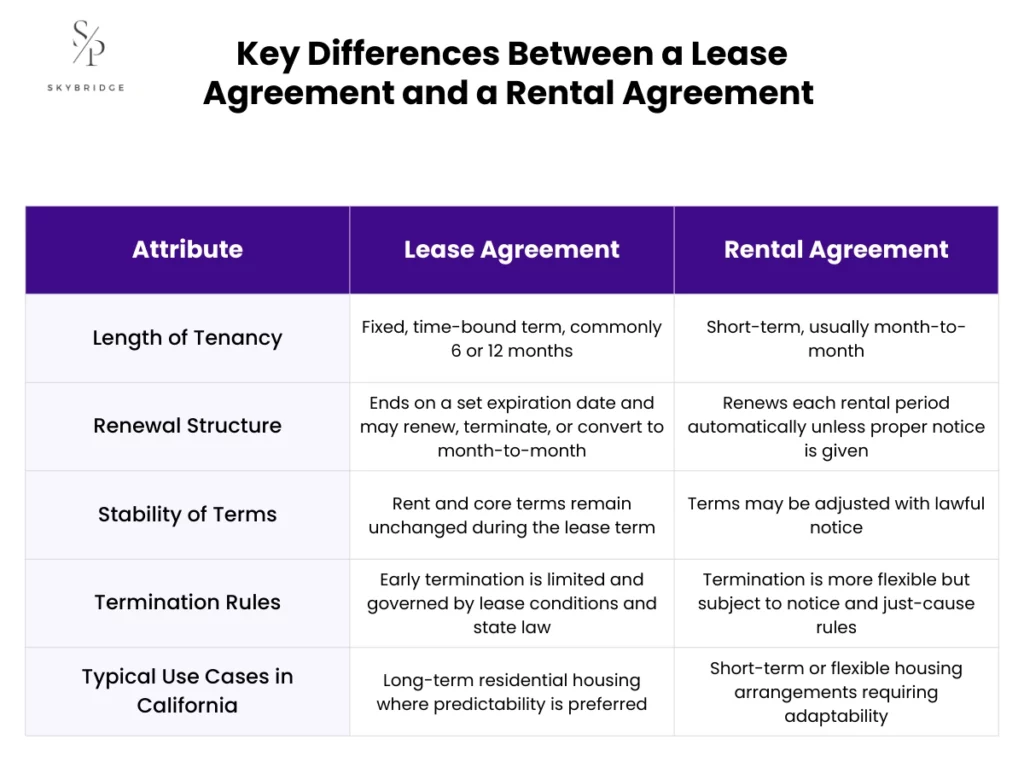
A lease agreement is a legally binding, long-term contract, typically lasting six to twelve months, with fixed terms that remain stable for the duration of the lease, while a rental agreement is a short-term, often month-to-month arrangement that renews automatically. In California, this distinction is significant because state and local landlord–tenant laws impose different rules for notice periods, rent adjustments, renewals, and termination protections depending on whether the agreement is a lease or a rental agreement.
Key Differences Between a Lease Agreement and a Rental Agreement are:
How to Create a Rental Lease Agreement in California?
Creating a rental lease agreement in California begins with using a California-specific lease form and continues with incorporating all required disclosures, setting rent and security deposit terms, defining the lease duration and authorized occupants, outlining tenant responsibilities, and clarifying landlord entry rules. Each step must align with California law, including mandatory disclosures such as lead-based paint, Megan’s Law notice, mold information, and smoking policies, to reduce legal risk and ensure full compliance.
8 key steps to create a rental lease agreement in California are:
- Use a CA-Specific Lease Form
Every state within the U.S. has different landlord–tenant laws, and California is no exception, so the agreement process should begin with a state-specific, up-to-date California residential lease agreement template. Using a compliant form helps align the agreement with state requirements such as the Tenant Protection Act of 2019 (AB 1482), which governs rent limits and just-cause termination.
- Include All Mandatory Disclosures
As of 2026, California law requires landlords to provide several mandatory disclosures to tenants to maintain lease compliance. These include notices related to mold under Health and Safety Code sections 26147 and 26148, lead-based paint hazards for properties built before 1978, smoking policies under Civil Code section 1947.5, bed bug information, and Megan’s Law disclosures. Landlords must also disclose whether the rental unit includes a working stove and refrigerator, as these appliances are now tied to updated habitability standards.
- Set Rent & Deposit Terms
In this step, the financial foundation of the tenancy is established by defining the monthly rent amount, due date, accepted payment methods, and late fee policies, which are typically 5-10%. The lease must also specify the security deposit amount, how it is held, and the conditions for its return. In California, state law strictly caps security deposits, generally limiting them to 1-2 months’ rent depending on the tenancy type.
- Define Lease Term & Occupants
Specify whether the tenancy is fixed-term (e.g., a one-year lease) or month-to-month, and clearly identify all authorized occupants. Defining the lease duration and approved residents establishes clear occupancy boundaries, limits unauthorized use of the property, and supports enforceability under California landlord–tenant law.
- Outline Tenant Responsibilities
Tenant responsibilities, such as timely rent payments, proper care of the rental unit, adherence to house rules, utility payments (where applicable), and prompt reporting of maintenance issues, should be clearly outlined to establish enforceable expectations. Clearly defining these duties helps reduce disputes and supports compliance with California landlord-tenant laws throughout the tenancy.
- Clarify Landlord Entry Rules
The lease agreement should clearly define when and how a landlord may enter the rental property, balancing access rights with tenant privacy. To comply with California Civil Code section 1954, landlords are generally required to provide at least 24 hours’ written notice before entering the unit for non-emergency reasons, such as repairs or inspections. Stating these conditions in the lease helps prevent disputes and ensures lawful entry throughout the tenancy.
- Attach Required Addendums
Customizing the lease agreement with property-specific addendums for pets, smoking, parking, or shared-use areas, such as a refrigerator request addendum, ensures that local rules and special conditions are clearly documented and legally enforceable.
- Review and Execute the Agreement
The final step requires both parties to carefully review the completed lease to confirm all terms are accurate and no blank sections remain before signing. Once executed by all parties, the agreement becomes legally binding and enforceable under California law.
What Are the Key Components of a Rental Lease Agreement?
The key components of a rental lease agreement include core identification and basic terms, financial provisions, property condition and maintenance, rules, restrictions, and permitted use. Together, these lease agreement components define the landlord-tenant relationship, establish enforceable obligations, and ensure compliance with California housing laws.
Key components of a rental lease agreement include:
- Core Identification & Basic Terms: Identifies the landlord and tenant, the rental property address, the lease type, and the lease term. Clear identification confirms who is legally bound by the agreement and establishes the scope and duration of the tenancy.
- Financial Provisions: Specifies the rent amount, due dates, payment methods, late fees, and security deposit limits. Because California law regulates deposits and notice requirements, accurate documentation is necessary to avoid disputes and maintain compliance.
- Property Condition & Maintenance: Defines the condition of the rental unit at move-in and allocates maintenance and repair responsibilities. Clear terms support habitability standards and help prevent disputes.
- Rules, Restrictions, & Use: Governs how the property may be used, including policies on pets, smoking, noise, subletting, and occupancy limits, all of which must align with California housing regulations.
- Mandatory California Disclosures & Addenda: Required disclosures and addenda address habitability, safety, and local compliance obligations. Their inclusion ensures the lease meets state and local legal requirements.
- Legal & Procedural Clauses: Outlines enforcement rights, notice procedures, remedies for breach, and governing law, providing a framework for resolving disputes under California law.
- Signatures: Once signed, the rental lease agreement confirms mutual agreement and activates the contract as legally binding and enforceable.
What Are Red Flags in a Rental Lease Agreement?
Red flags in a rental lease agreement include missing or vague terms, excessive or hidden fees, illegal clauses, and requirements such as forced cash-only rent payments. In California, these warning signs often indicate non-compliance with landlord–tenant laws and can expose both parties to legal and financial risk.
Major red flags to avoid in a rental lease agreement include:
- Incomplete or Unclear Terms: Missing or vague information, such as the rent amount, unit address, lease duration, or payment schedule, can create confusion and weaken enforceability.
- Illegal Clauses: Provisions that waive the landlord’s responsibility for repairs, allow unlawful eviction, impose excessive late fees, or restrict tenant rights beyond what California law permits.
- Hidden Fees and Costs: Unexpected charges not disclosed upfront, including non-refundable cleaning fees or unexplained administrative costs.
- Unclear Maintenance Responsibilities: Lease language that fails to define repair obligations or attempts to shift habitability duties entirely to the tenant.
- Vague Security Deposit Policies: Lack of detail on the deposit amount, how it is held, or the timeline and conditions for its return.
- Unreasonable Entry Policies: Clauses allowing landlord entry without proper notice, which typically must be provided in advance except in emergencies.
- Automatic Renewal Without Notice: Terms that lock tenants into a new long-term lease without a clear option to terminate at the end of the current term.
Secure California Lease Compliance with a Professional Property Manager
Managing a rental lease agreement in California is difficult to handle independently because compliance involves overlapping state statutes, local ordinances, mandatory disclosures, rent control rules, and continuously evolving tenant protection laws. Errors such as missing required disclosures, misapplying AB 1482, or relying on outdated lease language can expose landlords to fines, disputes, or unenforceable agreements, particularly as regulations vary across cities and counties.
Professional property management mitigates these risks by centralizing compliance under experienced oversight. A licensed California property management company ensures that lease agreements comply with current legal requirements, include all mandatory disclosures and addenda, and adhere to lawful rent, deposit, and termination terms. Property managers also track notice requirements, manage tenant communication, document maintenance obligations, and enforce lease provisions consistently, allowing property owners to reduce liability and focus on long-term asset performance rather than navigating complex regulatory demands alone.