
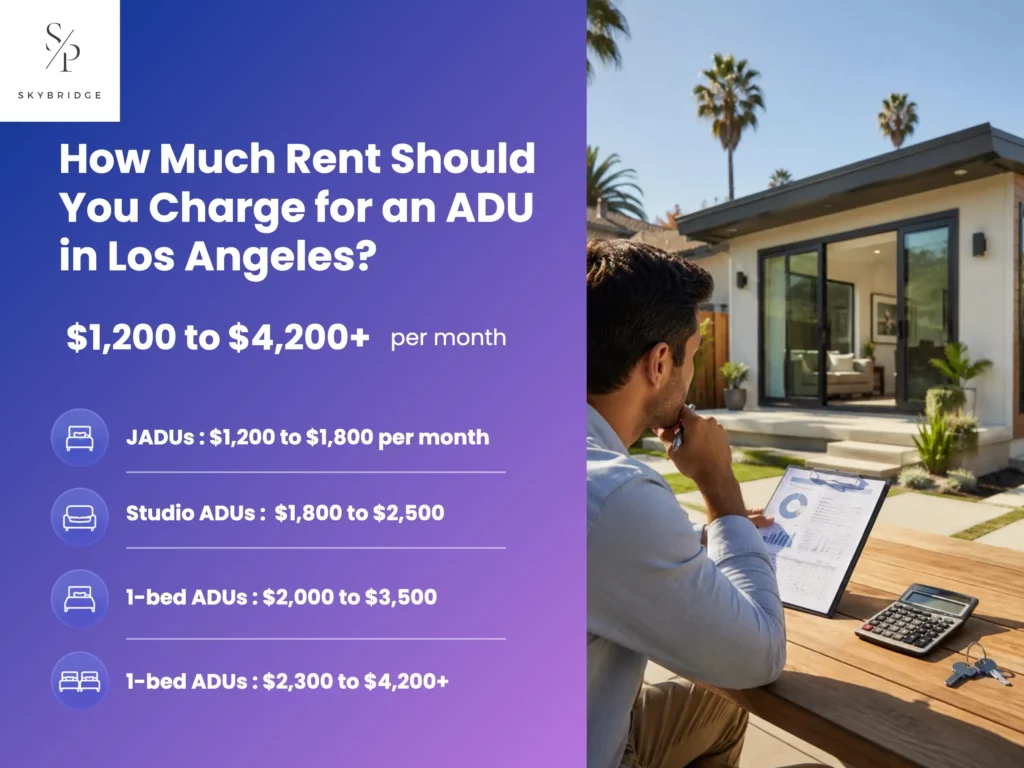
For ADUs in Los Angeles, you should charge from $1,200 to $4,200+ per month, with prices varying based on unit size, number of bedrooms, location, privacy, and overall property features. The citywide median rent for a well-finished Accessory Dwelling Unit (ADU) in Los Angeles is approximately $2,500 per month. In Los Angeles, JADUs rent around $1,200 to $1,800 per month, studio ADUs around $1,800 to $2,500, one-bedroom ADUs around $2,000 to $3,500, and two-bedroom ADUs around $2,300 to $4,200+ depending on features and demand. Setting the right rent requires understanding market demand, comparable listings, legal requirements, and the features that influence tenant decisions.
Accurate ADU pricing helps reduce vacancy, attract qualified tenants, maximize rental income, and keep rent aligned with market conditions. Owners should evaluate location, unit type, layout, parking, amenities, finishes, and permit status while comparing similar ADU listings within a 1 to 2-mile radius to establish an accurate rental range. Setting the right rent requires understanding market demand, comparable listings, legal requirements, and the features that influence tenant decisions. Understanding these variations helps homeowners set a competitive rent that supports tenant demand and long-term rental income.
Why Getting Your ADU’s Rent Price Right Matters?
Getting your ADU’s rent price right matters because it helps protect rental income by reducing vacancy loss, capturing fair market value, placing qualified tenants faster, lowering turnover costs, staying aligned with market changes, and preventing pricing disputes or renegotiation issues. A well-researched rent price from a local property manager balances attracting reliable tenants with achieving sustainable returns, given current local rental conditions.
6 key benefits of getting your ADU’s rent price right are:
- Prevents Vacancy Loss From Overpricing
Setting the right ADU rent price prevents extended vacancy periods caused by unrealistic pricing expectations. An overpriced unit often receives fewer inquiries because potential tenants compare it against similar local rentals. Accurate market-based pricing creates immediate interest, increases tenant visibility, and helps reduce the financial impact of an empty property. By maintaining competitive rent, ADU owners can protect monthly cash flow, avoid unnecessary income loss, and reduce the time required to find a suitable tenant.
- Avoids Leaving Income on the Table From Underpricing
Proper ADU rent pricing helps property owners capture the full earning potential of their rental unit without undervaluing their investment. Underpricing attracts tenants quickly, but it can reduce long-term revenue and limit the financial benefits of ownership. According to Realtor.com Economic Research, the median asking rent in Los Angeles County was approximately $2,603 per month. A 10% pricing mistake at this market level could reduce annual rental income by roughly $3,100, demonstrating why accurate ADU pricing is critical for maximizing rental returns.
- Speeds up Qualified Tenant Placement
A correctly priced ADU attracts serious renters actively searching for housing within their budget. Competitive pricing improves visibility among qualified applicants and increases the chances of receiving strong rental applications quickly. When the rent aligns with current market expectations, property owners spend less time promoting the unit and screening out unsuitable inquiries. This faster tenant placement process reduces vacancy periods while helping owners secure reliable occupants who meet their rental requirements.
- Reduces Turnover and Vacancy Costs
When an ADU is priced too high, it can sit vacant for weeks or months, while an unrealistically low price can reduce the owner’s potential rental income. Setting the right rent price creates a balanced rental experience by attracting suitable tenants and reflecting the property’s true value. Fair and market-aligned ADU rent pricing encourages tenant satisfaction, supports longer lease relationships, and reduces turnover-related expenses such as advertising, screening, cleaning, repairs, and vacancy preparation.
- Keeps Rent Aligned With Market Shifts
Regularly reviewing ADU rent pricing helps owners stay connected with changes in local rental demand, housing conditions, and economic trends. Market-aligned pricing allows property owners to make gradual adjustments instead of relying on sudden increases or decreases. This approach keeps the ADU competitive while maintaining a balanced relationship with current and future tenants. Consistent pricing evaluations help ensure the rental income reflects present market conditions and supports sustainable property performance.
- Minimizes Renegotiation and Pushback
When potential tenants question an ADU’s rental price or request a lower rate, accurate pricing helps minimize renegotiation and pushback by providing clear justification. A rent amount based on comparable properties, local market demand, and ADU features allows owners to explain the value behind the price. This transparency reduces disagreements, increases tenant confidence, and creates a smoother leasing process with fewer pricing objections from the initial inquiry through lease signing.
What Determines an ADU’s Rental Value in Los Angeles?
An ADU’s rental value in Los Angeles depends on factors such as location, neighborhood demand, unit size and layout, unit type, parking availability, interior finishes, amenities, in-unit laundry, and permit or legal compliance status. Each factor influences tenant interest, market competitiveness, and the rental income an ADU in Los Angeles can generate by determining how the property compares with similar units in the local housing market.
6 key factors that determine an ADU’s rental value in Los Angeles are:
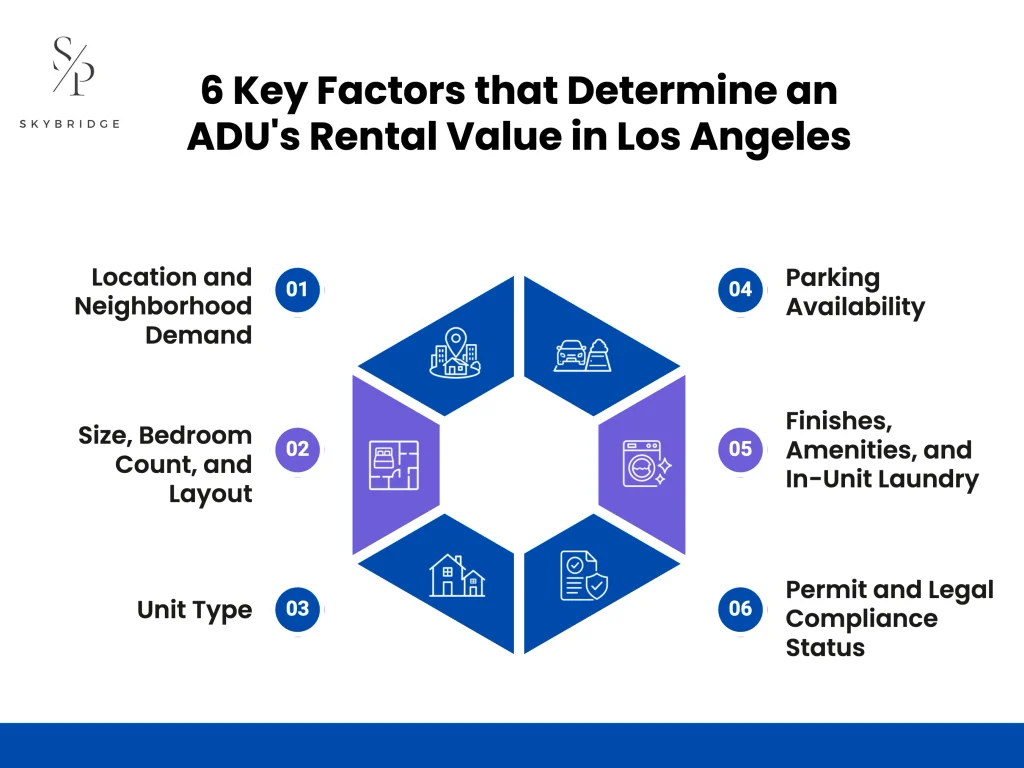
- Location and Neighborhood Demand
- Size, Bedroom Count, and Layout
- Unit Type
- Parking Availability
- Finishes, Amenities, and In-Unit Laundry
- Permit and Legal Compliance Status
Which Los Angeles Rules Should You Check Before Setting Your ADU Rent?
You should check RSO and AB 1482 rent cap coverage, local rent stabilization rules, your property’s construction date, and your unit’s permit status before setting your ADU rent in Los Angeles. Reviewing rent increase restrictions, long-term and short-term rental rules, and registration requirements helps property owners set compliant rental prices, avoid legal issues, and make informed decisions based on current housing regulations.
4 key Los Angeles rules you should check before setting your ADU rent are:
- RSO and AB 1482 Rent Cap Coverage
Before setting your ADU rent, you need to determine whether your unit is subject to the Los Angeles Rent Stabilization Ordinance (RSO) or AB 1482. RSO applies to buildings built before October 1978, but newly constructed ADUs are usually exempt based on their own construction date and whether they are attached or detached. AB 1482 provides statewide rent increase limits and tenant protection requirements for eligible rental units that are not covered by RSO. Confirming your property status through the City of Los Angeles Housing Department (LAHD) ZIMAS tool or RSO Determinations Unit helps you set a compliant rental price.
- Rent Increase Restrictions
Once a tenant moves in, how much you can raise rent depends on which law covers your unit. RSO covered units are capped at 3% per year through June 2027. AB 1482 units get a higher limit tied to regional CPI, currently 8.7% in the LA metro area, calculated as 5% plus CPI and capped at 10%, with no more than two increases in any 12-month period. Going over these caps or raising rent too often can lead to tenant relocation payments, forced rent rollbacks, and other penalties.
- Long-Term vs. Short-Term Rental Rules
Los Angeles requires ADUs to be rented long-term, with lease terms of at least 30 consecutive days. Short-term listings on Airbnb or Vrbo are prohibited in nearly every case, even if you live on the property. The only exception applies to ADUs with a certificate of occupancy issued before January 1, 2017, a rule based on the unit’s build date, not its occupancy date. Since most ADUs are newer, this exception rarely applies. Violating the rule risks fines up to $2,000 per day and listing removal.
- Registration Required Before Renting
Every residential rental in Los Angeles, including ADUs, must be registered annually with the LA Housing Department. This requires paying applicable fees under the RSO, Just Cause Ordinance, and Systematic Code Enforcement Program (SCEP). Adding an ADU brings your whole property into SCEP’s scope, subjecting it to habitability inspections roughly every 4 years. You need a valid registration certificate and must give tenants the required disclosures before legally collecting rent. Skipping registration can also block you from enforcing your lease or evicting later.
How to Conduct an ADU Rental Comparable Analysis?
Conducting an ADU rental comparable analysis involves finding 3 to 5 similar ADU listings within a 1 to 2-mile radius and comparing factors such as unit type, size, bedroom count, parking, and amenities. Reviewing active listings, analyzing days on market, excluding outdated or unrealistic comparables, and adjusting for property differences help establish an accurate rental range rather than relying on a single fixed price.
7 ways to conduct an ADU Rental comparable analysis include:
- Find 3–5 Comparable ADU Listings Within a 1–2 Mile Radius
Start by comparing a small sample of nearby ADU listings using hyper-local data from platforms like Zillow, Trulia, or local MLS databases. For a 1-bedroom, 600 sq. ft. detached ADU in North Hollywood, compare 3 to 5 similar units within a 1 to 2-mile radius with matching square footage, parking options, amenities, school districts, and transit access. This focused approach keeps rental comparisons relevant because local demand and neighborhood features influence pricing.
- Match Unit Type, Size, and Bedroom Count Closely
A comparable listing should closely match your ADU’s key property characteristics to provide an accurate rental estimate. Focus on units with similar square footage, bedroom and bathroom count, and overall layout. The unit type should also match, for example, by comparing a detached ADU with other detached ADUs or an attached ADU with similar attached units. Properties with significant differences in size, design, or structure can lead to inaccurate comparisons and an unrealistic rental price.
- Check Active Listings, Not Just Closed/Past Leases
When conducting an ADU rental comparable analysis, review active listings to understand the current asking prices in your local market. Past lease prices can provide historical context, but they may not reflect today’s rental conditions due to changes in demand, new inventory, or seasonal trends. Focus on active, comparable ADUs to identify the price range tenants are currently seeing, and use this information to set a competitive rental rate based on current market conditions.
- Note Days-On-Market to Spot Over/Underpriced Comps
Track how long comparable ADU listings remain available to understand whether their asking prices match market expectations. Listings that stay active for several weeks without tenant interest indicate an overpriced rental rate and should not be used as a strong pricing benchmark. On the other hand, units that receive applications quickly suggest that the rent was set below the potential market value. Reviewing days on market helps you identify realistic pricing patterns and avoid relying on inaccurate comparables.
- Adjust for Differences (Parking, Amenities, Unit Type)
Adjust the rental estimate based on features such as parking, amenities, unit type, and included services that affect an ADU’s market value. Since comparable listings rarely match your ADU perfectly, evaluate the differences and adjust the price accordingly. For example, if a comparable ADU rents for $2,200 but does not include parking or laundry, while your ADU offers both features, your unit may support a higher rental price. These adjustments create a more accurate comparison and a realistic rental range.
- Exclude Outdated or Unrealistic “Aspirational” Listings
Remove outdated or unrealistic listings from your comparable analysis to avoid setting your ADU rent based on inaccurate pricing signals. Some listings reflect owner expectations rather than the amount tenants are actually willing to pay, while others may be outdated, inactive, or duplicated across rental platforms. Including these listings can inflate the rental estimate and make your ADU appear overpriced relative to actual market demand. Focus on active, realistic listings that reflect genuine tenant interest and current rental conditions to set a more accurate price.
- Set a Rental Range, Not a Single Fixed Number
Set a realistic rental range using your adjusted comparable listings rather than choosing a single fixed price. A rental range gives you flexibility to respond to tenant interest, market conditions, and property differences. For example, if similar ADUs in your area rent between $2,100 and $2,400 per month after adjusting for size, amenities, and condition, you can position your ADU within that range based on its features. Starting near the higher end leaves room for negotiation, while strong tenant interest confirms that your pricing aligns with market demand.
How to Calculate the Right Rent for Your ADU?
Calculating the right rent for your ADU involves using comparable rental data, adjusting for your unit’s features, considering permit status, accounting for vacancy risks, checking AB 1482 limits, and testing the price based on tenant interest and market response. This approach helps you set a competitive rental rate that balances income potential with faster tenant placement.
6 ways to calculate the right rent for your ADU include:
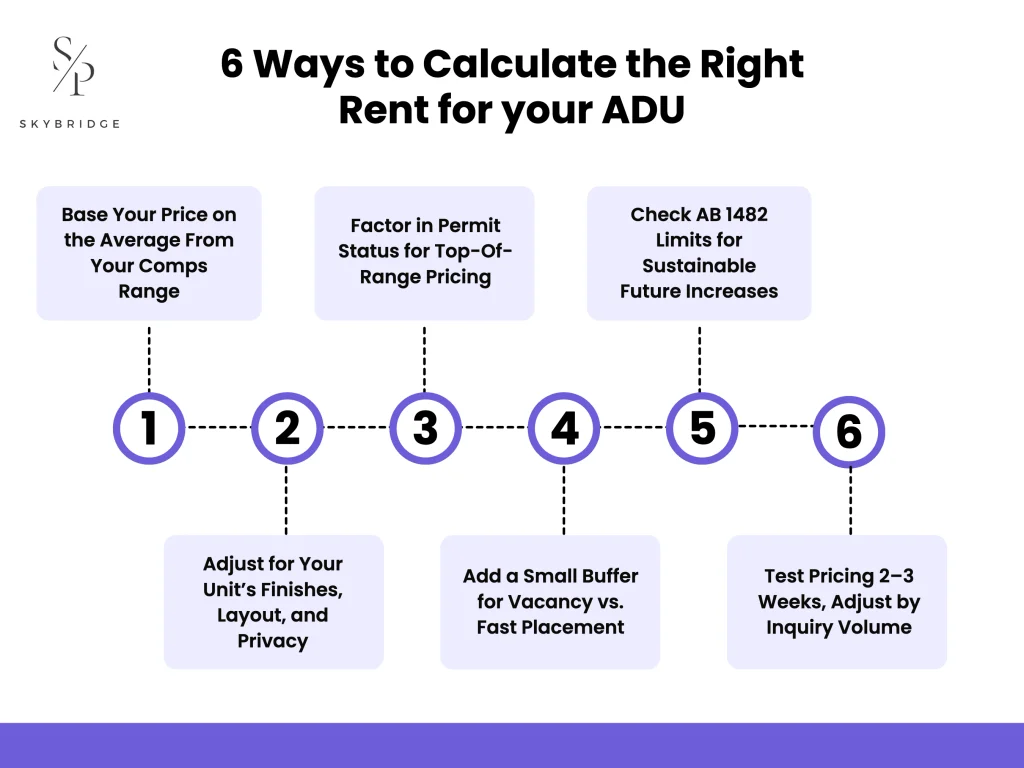
- Base Your Price on the Average From Your Comps Range
Start your ADU rental pricing process by using the average or midpoint of your comparable listings as the initial price reference. For example, if your adjusted comparable ADUs rent between $2,000 and $2,400 per month, the midpoint is around $2,200, which serves as your starting benchmark. After establishing this baseline, adjust the price based on your ADU’s condition, privacy, finishes, parking, and other features. This method keeps your pricing tied to real market data rather than guesswork.
- Adjust for Your Unit’s Finishes, Layout, and Privacy
Adjust your starting rental price based on your ADU’s quality, design, and privacy features relative to similar listings. Modern finishes, updated kitchens, in-unit laundry, efficient layouts, and greater privacy from the main home can support pricing toward the higher end of your range. Older interiors, limited functionality, shared spaces, or reduced privacy may require a lower price to remain competitive. These adjustments help ensure your final rent reflects your unit’s actual value and tenant appeal.
- Factor in Permit Status for Top-Of-Range Pricing
Consider your ADU’s permit status when setting the final rental price because legal compliance affects tenant confidence and market value. A fully permitted ADU with an approved certificate of occupancy provides tenants with greater assurance and can support pricing toward the higher end of the rental range. Units without proper permits may raise concerns about legal use, insurance, and tenant security, which can reduce demand and require more conservative pricing than fully permitted ADU listings.
- Add a Small Buffer for Vacancy vs. Fast Placement
Vacancy refers to the income loss that occurs when your ADU remains empty, while fast placement focuses on attracting tenants quickly to reduce downtime. When setting your rent, balance the goal of maximizing income with the need to avoid extended vacancy periods. A slightly lower price can increase tenant interest and speed up placement, while a higher price may take longer to secure a renter. Choosing the right balance helps protect rental income and maintain consistent occupancy.
- Check AB 1482 Limits for Sustainable Future Increases
Consider future rent increase limits before setting your starting ADU rent, especially if your unit is subject to AB 1482. This law limits annual rent adjustments to 5% plus regional CPI, with a maximum increase cap of 10% (currently 8.7% in the LA metro area). Setting the initial rent too low may limit your ability to reach market value later because future increases are restricted. A balanced starting price helps attract tenants while supporting sustainable long-term rental growth.
- Test Pricing 2–3 Weeks, Adjust by Inquiry Volume
Test your initial ADU rent price for 2 to 3 weeks and evaluate tenant interest before making a final decision. Track the number of inquiries, property showings, and rental applications to determine whether your price aligns with market demand. For example, if your ADU is listed at $2,500 per month and receives multiple qualified applications within the first week, the price may be competitive or support a higher rate. If it receives few inquiries after several weeks, consider reducing the rent to attract more tenants and avoid extended vacancy.
How Much Do ADUs Rent for in Los Angeles?
ADUs in Los Angeles rent from $1,200 to $4,200+ per month, with prices varying based on unit size, number of bedrooms, location, privacy, and overall property features. Smaller units such as Junior ADUs and studios fall toward the lower end of the range, while larger one-bedroom and two-bedroom ADUs with more living space can reach higher rental values. Factors such as neighborhood demand, parking availability, modern finishes, permits, and included amenities also influence where an ADU falls within this rental range.
Rent by Unit Type
- How Much Does a Junior ADU Rent for in Los Angeles?
A Junior ADU (JADU) in Los Angeles rents for around $1,200 to $1,800 per month, providing homeowners with an opportunity to generate additional rental income from existing residential space. The final rental value depends on factors such as location, unit size, privacy, finishes, amenities, and overall condition. JADUs with private access, updated interiors, functional layouts, and strong neighborhood demand can achieve higher rents, while units with shared spaces or fewer features may fall toward the lower end of the range.
- How Much Does a Studio ADU Rent for in Los Angeles?
A studio ADU in Los Angeles rents for around $1,800 to $2,500 per month, offering homeowners a way to create additional rental income from a small, independent living unit. It is influenced by factors such as neighborhood demand, unit size, privacy, parking availability, interior upgrades, and property amenities. Studio ADUs in desirable locations, with modern finishes, private entrances, and added conveniences, can attract stronger tenant interest and support higher rental rates.
- How Much Does a One-Bedroom ADU Rent for in Los Angeles?
A one-bedroom ADU in Los Angeles rents for $2,000 to $3,500 per month, creating an opportunity for homeowners to earn rental income from a private, functional living space. Rental rates are influenced by market demand, neighborhood location, ADU size, interior design, privacy, parking options, and available amenities. Properties with well-designed layouts, modern upgrades, and features that improve tenant comfort can attract renters willing to pay higher monthly rates.
- How Much Does a Two-Bedroom ADU Rent for in Los Angeles?
A two-bedroom ADU in Los Angeles rents for around $2,300 to $4,200+ per month. The higher rental range is driven by increased living space, additional bedrooms, and broader tenant appeal among families, roommates, and renters seeking more functional layouts. Factors such as location, unit design, privacy, parking, interior upgrades, and included amenities determine where the property falls within this range.
ADU Rent Differences by Los Angeles Neighborhood
ADU rental prices in Los Angeles vary significantly by neighborhood due to differences in housing demand, location, amenities, property values, and tenant preferences. The table below provides estimated monthly rent ranges by ADU type across different areas.
| Los Angeles Neighborhood | Junior ADU (JADU) | Studio ADU | 1-Bedroom ADU | 2-Bedroom ADU |
| Diamond Bar | $1,200–$1,600/month | $1,600–$2,100/month | $1,900–$2,600/month | $2,500–$3,400+/month |
| Long Beach | $1,300–$1,800/month | $1,800–$2,500/month | $2,300–$3,200/month | $3,000–$4,200+/month |
| Riverside | $1,100–$1,500/month | $1,600–$2,100/month | $1,900–$2,600/month | $2,400–$3,300/month |
| Pomona | $1,100–$1,500/month | $1,600–$2,100/month | $1,900–$2,700/month | $2,500–$3,500/month |
| Pasadena | $1,400–$1,900/month | $2,000–$2,700/month | $2,500–$3,500/month | $3,200–$4,500+/month |
| Glendale | $1,400–$1,900/month | $2,000–$2,800/month | $2,600–$3,600/month | $3,300–$4,800+/month |
| Burbank | $1,400–$1,900/month | $2,000–$2,700/month | $2,500–$3,500/month | $3,200–$4,500+/month |
What Common Mistakes Should You Avoid When Pricing an ADU?
Common ADU pricing mistakes include relying on citywide averages rather than hyper-local comparable listings, comparing the wrong ADU types, ignoring days on market as a pricing indicator, and skipping adjustments for differences in amenities, finishes, parking, and unit features. Other mistakes include setting rent based on mortgage payments or construction costs rather than actual market value. Avoiding these mistakes helps property owners create a data-driven pricing strategy that attracts qualified tenants while achieving a competitive rental return.
6 common mistakes you should avoid when pricing an ADU are:
- Using a Citywide Average Instead of Hyper-Local Comps
- Comparing Against the Wrong ADU Type
- Ignoring Days-On-Market as a Pricing Signal
- Skipping Amenity Adjustments When Comparing Rents
- Pricing Based on Mortgage or Construction Cost, Not Market Value
- Waiting Too Long to Correct an Overpriced Listing