

If a tenant abandons property in California, confirm the signs of abandonment, attempt to contact the tenant, serve a Notice of Belief of Abandonment, and retake possession of the rental unit in accordance with California law. Additionally, inventory the remaining belongings, send a Notice of Right to Reclaim, store the property until the statutory deadline, return claimed items, dispose of or auction unclaimed property based on the $700 threshold, and settle the security deposit.
Even after the belongings are removed, homeowners should understand how the tenant’s rights change if they return during or after the statutory notice period. California law also allows tenants to reclaim property, receive written notice, dispute an abandonment claim, and recover damages if the required legal procedures are not followed.
To avoid legal disputes, homeowners should steer clear of common abandonment mistakes and reduce the risk of future tenant abandonment by using clear lease terms, thoroughly screening tenants, collecting the maximum lawful security deposit, maintaining a consistent rent collection system, responding promptly to late rent, and managing the property proactively.
10 methods to follow if a tenant abandoned property in California are:
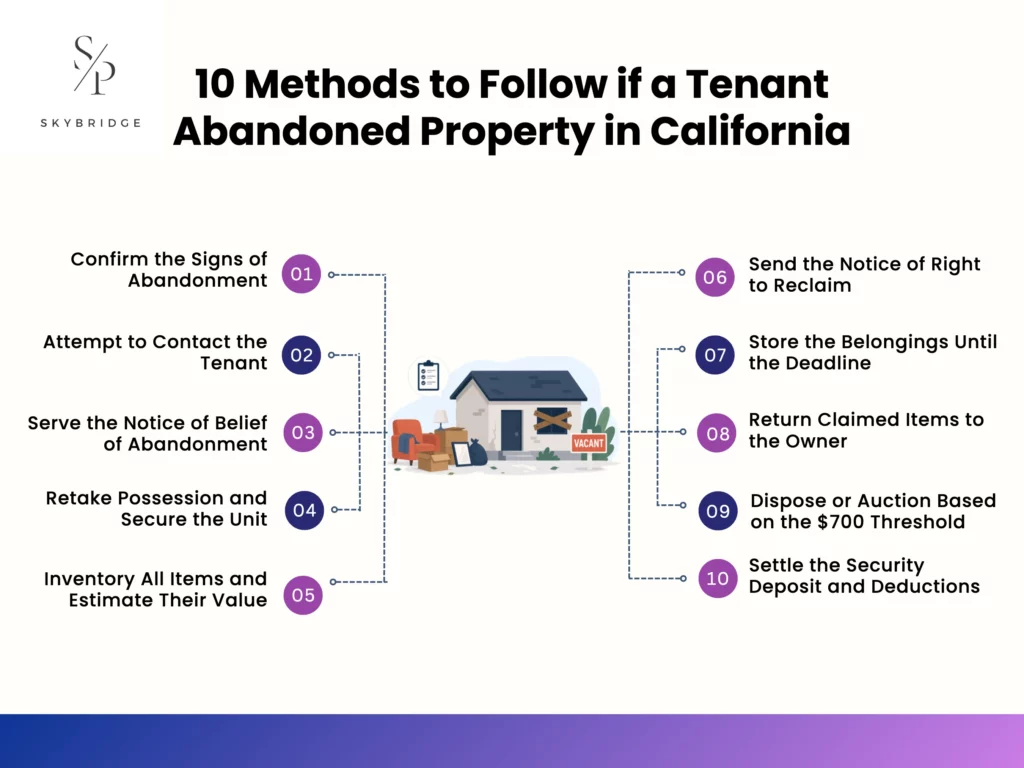
- Confirm the Signs of Abandonment
- Attempt to Contact the Tenant
- Serve the Notice of Belief of Abandonment
- Retake Possession and Secure the Unit
- Inventory All Items and Estimate Their Value
- Send the Notice of Right to Reclaim
- Store the Belongings Until the Deadline
- Return Claimed Items to the Owner
- Dispose or Auction Based on the $700 Threshold
- Settle the Security Deposit and Deductions
- Confirm the Signs of Abandonment
Verify that the tenant has legally abandoned the rental property before taking possession by confirming both the legal requirements and clear signs of abandonment. In California, rent should be unpaid for at least 14 consecutive days. Look for evidence such as disconnected utilities, an empty refrigerator, removed furniture, accumulated mail, or confirmation from neighbors that the tenant has permanently moved out. Document everything with dated photos, videos, and written notes to support your decision and reduce the risk of an illegal lockout claim.
- Attempt to Contact the Tenant
Before serving statutory notices, make a diligent effort to reach the tenant through every available contact method, including phone, text, email, and designated emergency contacts. Documenting these outreach attempts demonstrates good faith and reasonable diligence. This strengthens your legal standing if the tenant later claims they were temporarily absent due to hospitalization, emergency, or travel rather than intending to surrender the unit. Exhausting standard communication channels early often clarifies the situation quickly, potentially saving landlords from unnecessary legal delays, administrative costs, and prolonged vacancies.
- Serve the Notice of Belief of Abandonment
To legally establish abandonment of real property under California Civil Code Section 1951.3, serve a formal Notice of Belief of Abandonment specifying the lease termination date. The statutory waiting period requires giving the tenant 15 calendar days if hand-delivered or 18 calendar days if mailed to respond. If the tenant pays overdue rent or submits a written statement declaring their intent not to abandon before the notice expires, the abandonment process immediately halts and standard eviction proceedings must be pursued instead to lawfully regain possession.
- Retake Possession and Secure the Unit
Only after the Notice of Belief of Abandonment expires without a tenant response or rent payment can you legally re-enter the unit and change the lock cylinders. Entering the premises prior to full statutory expiration constitutes an illegal lockout under California law, exposing landlords to statutory damages up to $100 per day plus actual damages. Once the deadline cleanly passes, secure all entry points, record the precise date of physical takeover, and prepare to inventory any personal property left behind by the former occupants.
- Inventory All Items and Estimate Their Value
Create a detailed inventory of all personal property left behind and estimate its total resale value before disposing of anything. Under California Civil Code §§ 1983-1988, record every item, including furniture, electronics, clothing, documents, appliances, and household goods, along with its condition and estimated resale value rather than its original purchase price. Take dated photographs and notes to support your inventory, as the total resale value determines whether the property can be privately disposed of or must be sold at a public auction.
- Send the Notice of Right to Reclaim
Under California Civil Code § 1983, landlords must serve a written Notice of Right to Reclaim Personal Property detailing the specific items found, where they are being held, and the cost structure for storage fees. The notice must grant the tenant or lienholder 15 days to claim if delivered in person or 18 days if delivered by mail, while explicitly warning them of the legal disposition path that will follow if the items remain unclaimed past the strict statutory deadline.
- Store the Belongings Until the Deadline
Safeguard the abandoned belongings throughout the statutory reclaim period before releasing or disposing of them. California law requires landlords to hold the property for at least 15 days after personal service or 18 days after mailing the notice. Store the items securely in the rental unit or a commercial storage facility and protect them from theft, weather, and damage. You may recover reasonable moving and storage costs where permitted by law.
- Return Claimed Items to the Owner
Release the abandoned belongings to the tenant if they are reclaimed within the legal deadline. Verify the claimant’s identity before returning the property and collect only legally recoverable moving or storage costs. If the property is scheduled for a public auction, the tenant may generally reclaim it before the sale by paying the applicable storage and advertising expenses. Obtain a signed receipt confirming the return of all belongings.
- Dispose or Auction Based on the $700 Threshold
Sell, donate, discard, or auction the unclaimed belongings based on their total estimated resale value after the reclaim period expires. Under California Civil Code § 1988, property with a total resale value of $700 or less can be kept, donated, sold, or discarded. If the property’s total resale value exceeds $700, it must be sold through a properly advertised public auction. Apply the auction proceeds toward lawful storage and advertising costs, then remit any remaining surplus to the county treasury as required by California law.
- Settle the Security Deposit and Deductions
Within 21 calendar days of regaining physical possession of the unit, you must finalize the security deposit accounting in compliance with California Civil Code Section 1950.5. Deliver an itemized statement detailing all allowable deductions, such as unpaid rent, repair costs beyond normal wear and tear, and extraordinary cleaning fees, along with invoices, receipts, and any remaining deposit balance mailed to the tenant’s last known address. Strict adherence to this timeframe avoids forfeiting your right to retain deposit funds for valid tenant damages.
What to Do If the Tenant Returns After You Disposed of Their Belongings?
If a tenant returns after you have disposed of their belongings, immediately pause communication, review your local laws and the lease agreement, and gather all move-out or eviction documentation. Your legal obligations then depend on whether the tenant returned during the statutory notice period or after the notice period had expired and the property was lawfully disposed of under California law. The tenant’s rights vary based on the timing of their return and whether the legal disposal process was completed.
Below are the most common scenarios and the appropriate actions to take in each situation:
- Tenant Returns During the Notice Period
Allow the tenant to reclaim their belongings if they return before the statutory notice period expires. Under California Civil Code §§ 1983-1987, the tenant has 15 days after personal service or 18 days after mailed notice to reclaim their property. Verify the tenant’s identity before releasing the belongings and collect only legally recoverable storage costs where permitted. Do not dispose of, sell, or withhold the property during this period because the tenant’s legal right to reclaim it remains in effect.
- Tenant Returns After the Notice Period Has Expired
Dispose of, sell, or auction the belongings only after the statutory notice period expires without a response from the tenant. Under California Civil Code § 1988, once property has been lawfully disposed of following the required notice procedures based on the $700 value threshold, the tenant generally loses the right to reclaim it. However, if the notice stated the property would be sold at public auction, the tenant may still reclaim it any time before the actual sale date by paying accrued storage and advertising costs. Failure to follow statutory requirements can expose the landlord to liability for the property’s value plus additional damages.
What Rights Does the Tenant Still Have After Abandoning Property in California?
California law allows tenants to reclaim their belongings during the notice period, receive written notice at their last known address, dispute a landlord’s abandonment claim, and recover damages if the landlord fails to follow the required legal procedures. Understanding these rights helps both landlords and tenants comply with California’s abandoned property laws and avoid unnecessary legal disputes.
Below are the rights tenants still have after abandoning property in California:
- Right to Reclaim Property Within the Notice Period
Tenants maintain the absolute legal right to recover their personal belongings before the statutory notice period expires. Under California Civil Code Sections 1983 through 1987, tenants are granted 15 calendar days following personal delivery or 18 calendar days following mailed notice to reclaim their items. Landlords must surrender the property once reasonable storage fees are paid and cannot hold personal belongings hostage to collect unpaid back rent, as withholding property for unpaid rent constitutes an illegal conversion under state law.
- Right to Receive Written Notice at Last Known Address
California state law guarantees that proper written notification regarding both real property abandonment and personal property disposition must be delivered to the tenant’s record. Under California Civil Code Section 1951.3 and Section 1983, landlords must send a Notice of Belief of Abandonment and a Notice of Right to Reclaim Personal Property to the last known address and any secondary contact on file. This step ensures fair opportunity and legal due process before lease termination or property disposal occurs.
- Right to Dispute the Abandonment Claim
An occupant holds the explicit legal power to halt abandonment proceedings by serving a written statement declaring their intent not to surrender the property. If this notice is delivered or outstanding rent is paid before the statutory window expires, the landlord cannot legally retake possession under California Civil Code Section 1951.3. Instead, the property owner must immediately stop the abandonment process and pursue formal judicial eviction proceedings through the courts to regain physical possession.
- Right to Recover Damages If the Landlord Skips Legal Steps
If a landlord fails to send proper notice, disposes of property before the notice period ends, or sells items below the $700 threshold at auction without justification, the tenant can sue for the property’s fair value plus additional damages under California law. Courts impose enhanced penalties if the landlord acted in bad faith or with deliberate disregard for statutory procedure. Carefully following Civil Code §§ 1983-1988 is the landlord’s primary legal protection against such claims.
What Mistakes Should Homeowners Avoid With Abandoned Property?
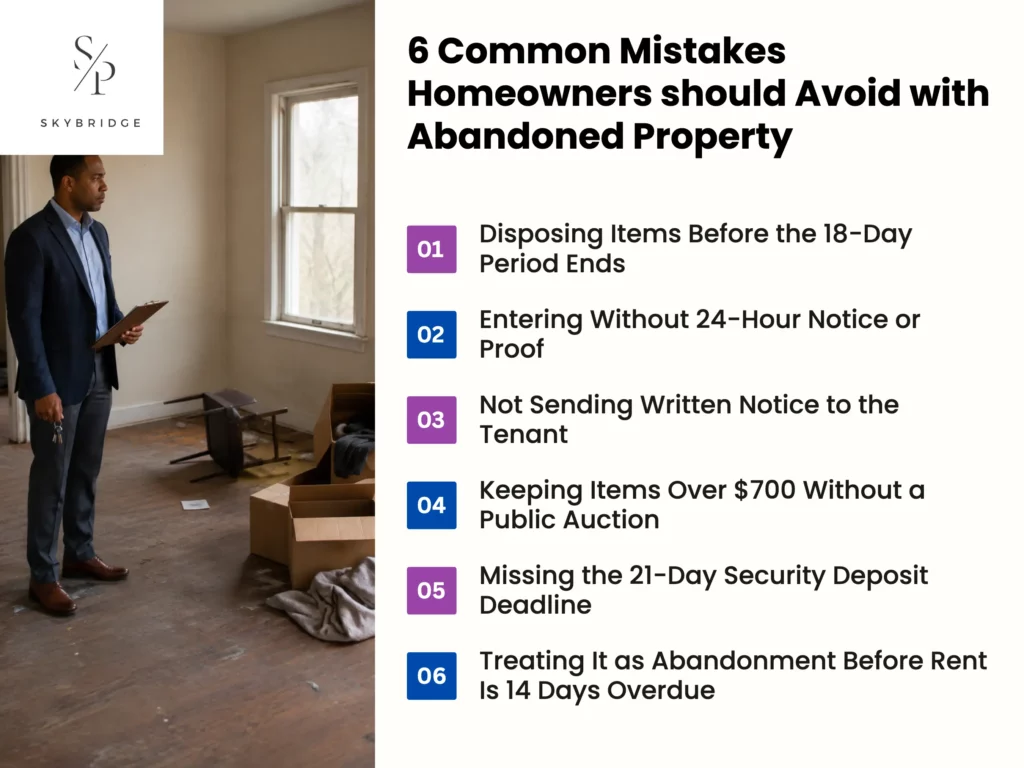
Homeowners should avoid violating California’s abandoned property laws by waiting until the 18-day notice period expires before disposing of belongings, providing all required written notices, and entering the property only after giving proper notice or obtaining clear evidence of abandonment. They should also avoid keeping property valued above $700 without a public auction, missing the 21-day security deposit deadline, or treating the rental as abandoned before rent is 14 consecutive days overdue.
6 common mistakes homeowners should avoid with abandoned property are:
- Disposing Items Before the 18-Day Period Ends
- Entering Without 24-Hour Notice or Proof
- Not Sending Written Notice to the Tenant
- Keeping Items Over $700 Without a Public Auction
- Missing the 21-Day Security Deposit Deadline
- Treating It as Abandonment Before Rent Is 14 Days Overdue
How Can Homeowners Reduce the Risk of Tenant Abandonment?
Homeowners can reduce the risk of tenant abandonment by including clear move-out and notice terms in the lease, thoroughly screening tenants before signing, collecting the maximum security deposit permitted under California law, and maintaining a consistent rent collection system throughout the tenancy. You should also act immediately when rent becomes overdue, hire a professional local property manager if needed, and maintain regular communication with tenants to resolve issues before they lead to abandonment.
6 methods to reduce the risk of tenant abandonment are:
- Include Clear Move-Out and Notice Terms in the Lease
- Screen Tenants Thoroughly Before Signing
- Collect a Full Security Deposit Allowed Under California Law
- Set Up a Consistent Rent Collection System
- Act Immediately When Rent Is Late
- Hire a Professional Local Property Manager
- Maintain Regular Communication With Tenants