

To evict a tenant, verify their legal status, document valid grounds, serve the required notice, wait for the notice period to expire, file an unlawful detainer action, serve court papers, present evidence at the hearing, obtain a judgment and writ of possession, and have law enforcement carry out the lockout. Common grounds for eviction include non-payment of rent, lease violations, unauthorized occupants, property damage, nuisance behavior, illegal activity, and lease expiration or holdover tenancy.
In California, landlords must follow the unlawful detainer process by serving the correct eviction notice, filing a court case, obtaining a Judgment of Possession and Writ of Possession, and having the sheriff enforce the eviction. Notice options include a 3-Day Notice to Pay or Quit, a 30-Day Notice to Vacate, a 60-Day Notice to Vacate, a Notice for Lease Violations or Nuisance, and a Notice to Quit. The eviction timeline varies based on notice requirements, court proceedings, and whether the tenant contests the case, while tenants retain rights to written notice, due process, and a court hearing.
9 steps to evict a tenant from your home include:
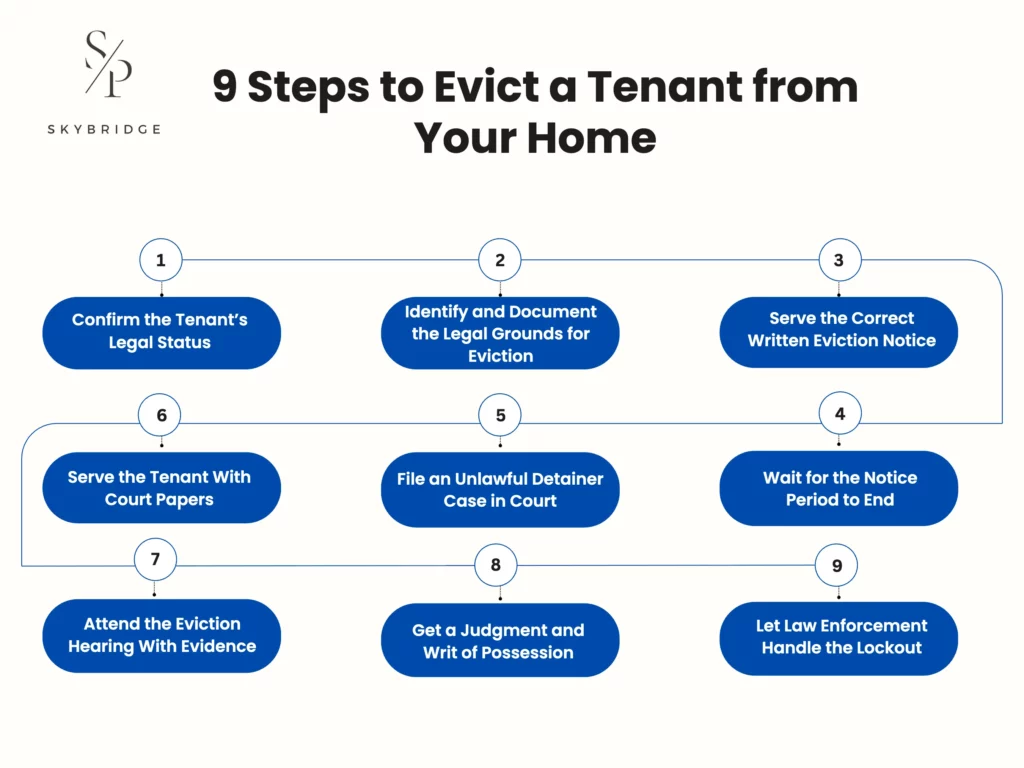
- Confirm the Tenant’s Legal Status
- Identify and Document the Legal Grounds for Eviction
- Serve the Correct Written Eviction Notice
- Wait for the Notice Period to End
- File an Unlawful Detainer Case in Court
- Serve the Tenant With Court Papers
- Attend the Eviction Hearing With Evidence
- Get a Judgment and Writ of Possession
- Let Law Enforcement Handle the Lockout
Confirm the Tenant’s Legal Status
Verify the occupant’s legal status before starting any eviction process, as legal requirements and procedures vary depending on whether the individual is a tenant, guest, roommate, or squatter. Proper classification helps determine the notices, court filings, and legal actions required under state and local law.
- Determine whether the occupant is a formal tenant by reviewing lease agreements, rental payment records, or other documents that establish a landlord-tenant relationship.
- Verify whether the occupant pays rent or has a written or verbal rental agreement. Formal tenants receive protections under state landlord-tenant laws.
- Assess whether the occupant is a guest or a roommate permitted to stay at the property without a formal lease agreement. Their rights differ based on the length of occupancy and financial contributions.
- Confirm whether the occupant contributes toward rent, utilities, or household expenses, as these factors influence the legal classification of the occupancy arrangement.
- Identify whether the occupant is a squatter who occupies the property without permission and without paying rent.
- Review applicable state and local regulations to determine the correct legal procedure for removing a squatter, as these cases often follow a different process than tenant evictions.
- Avoid self-help eviction methods such as changing locks, disconnecting utilities, removing belongings, or denying access to the property. These actions can result in legal penalties, financial consequences, and civil liability.
- Follow all state and local eviction requirements before taking action. In California, for example, the formal eviction process is known as an unlawful detainer case.
Identify and Document the Legal Grounds for Eviction
Classify and document the legal grounds for eviction before starting the eviction process. Valid reasons for eviction must be supported with records, notices, and evidence that comply with state and local requirements.
- Maintain a rent ledger and records of missed payments when the eviction is based on nonpayment of rent.
- Document lease violations such as unauthorized pets, unauthorized subletting, or excessive noise, and keep copies of the signed lease and any written warnings.
- Collect evidence of illegal activity on the property, including police reports, witness statements, or other supporting documentation.
- Retain copies of expired leases and written requests to vacate when the eviction involves a holdover tenant.
- Keep copies of all notices served to the tenant and organize supporting records before filing an eviction case.
Serve the Correct Written Eviction Notice
Provide the correct written eviction notice to formally begin the eviction process. The notice must match the reason for eviction and clearly explain what action the tenant must take to resolve the issue or vacate the property.
- Serve a 14-Day Notice to Pay or Quit when the tenant has failed to pay rent.
- Issue a 10-Day Notice to Cure for lease violations such as unauthorized pets, unauthorized occupants, or repeated noise complaints.
- Provide a 30- to 90-Day Notice to Vacate when ending a month-to-month tenancy or after a lease term expires.
- Ensure the notice includes the reason for eviction, required corrective action, and applicable deadline.
- File an eviction case with the local court if the tenant does not comply with the notice within the required timeframe.
Wait for the Notice Period to End
Stay until the required notice period ends before taking further legal action. This waiting period gives the tenant an opportunity to comply with the notice by paying rent, correcting a lease violation, or vacating the property.
- Allow the full notice period specified in the eviction notice to expire.
- Monitor whether the tenant pays the rent, resolves the violation, or moves out.
- Avoid changing locks, shutting off utilities, or removing the tenant’s belongings.
- Prepare documents such as the lease agreement, eviction notice, and proof of service.
- File an unlawful detainer case if the tenant remains on the property after the notice period ends.
File an Unlawful Detainer Case in Court
Document an unlawful detainer case in court if the tenant does not leave after the eviction notice period expires. This legal process allows a landlord to seek a court order for possession of the property and recover the rental unit through the court system.
- Serve the tenant with a written Notice to Quit before filing the eviction case.
- Provide the required notice period based on the reason for eviction, such as a 10-day notice for nonpayment of rent or illegal drug activity, or a 15- to 30-day notice for lease violations or lease expiration.
- File an Eviction Complaint with the local court if the tenant remains on the property after the notice period ends.
- Notify the tenant of the court papers and the hearing after the complaint is filed.
- Attend the court hearing where both parties can present evidence and testimony.
- Obtain an Order for Possession if the court rules in favor of the landlord.
- Avoid self-help eviction methods, such as changing locks or removing belongings, without a court order.
Serve the Tenant With Court Papers
Notify the tenant with court papers after filing the eviction lawsuit to officially notify them of the case and hearing date. Court documents must be served in accordance with local service requirements before the case can proceed.
- Arrange for a neutral third party to deliver the Summons and Complaint to the tenant.
- Use an authorized server, such as a county sheriff, constable, professional process server, or a neutral adult over the age of 18 who is not involved in the case.
- Deliver the court papers directly to the tenant through personal service whenever possible.
- Use posting and mailing methods, if permitted by local law, when attempts at personal service are unsuccessful.
- Attend the scheduled eviction hearing after the tenant has been properly notified of the lawsuit.
Attend the Eviction Hearing With Evidence
Present evidence at the eviction hearing to prove the legal grounds for eviction and support your case before the judge. Well-organized documentation helps demonstrate compliance with eviction requirements and strengthens the landlord’s position in court.
- Bring three copies of the lease agreement to establish the rental terms and tenant obligations.
- Provide three copies of the eviction notice and proof of delivery to show that proper notice was given.
- Present financial records, such as rent ledgers and bank statements, to document unpaid rent or payment history.
- Submit evidence of lease violations, including emails, written warnings, photographs, or incident reports.
- Organize all documents before the hearing so the judge, tenant, and landlord can review the evidence during the proceedings.
Get a Judgment and Writ of Possession
Obtain a judgment and writ of possession after the court rules in favor of the landlord. A Judgment of Possession confirms that the landlord has successfully proven the eviction case and is legally entitled to recover the rental property. A Writ of Possession authorizes law enforcement to enforce the court’s order and remove the tenant if they do not vacate voluntarily.
- Receive a Judgment of Possession confirming the landlord’s right to reclaim the property.
- Request a Writ of Possession from the court clerk after the judgment is issued.
- Wait for any required post-judgment period before the writ can be issued.
- Provide the writ to law enforcement, such as a sheriff or constable, for enforcement.
- Allow law enforcement to notify the tenant and carry out the removal if the tenant does not vacate voluntarily.
- Avoid changing locks or removing belongings without a court order and law enforcement involvement.
Let Law Enforcement Handle the Lockout
Allow law enforcement to handle the lockout after the court issues a judgment and writ of possession. Only authorized officers, such as the sheriff’s office, can enforce an eviction and physically remove a tenant.
- Serve a written notice to vacate before filing an eviction lawsuit.
- Use the required notice period based on the eviction reason, such as 7 days for nonpayment of rent, 14 days for health or safety violations, and 30 days for no-cause or month-to-month terminations.
- File a Forcible Detainer Action if the tenant does not leave after the notice period.
- Provide the Writ of Possession to law enforcement after the court issues it.
- Allow law enforcement to schedule and carry out the lockout if the tenant remains on the property.
- Do not change locks, shut off utilities, or remove the tenant’s belongings yourself.
What Are Valid Grounds for Evicting a Tenant?
7 valid grounds for evicting a tenant include:
- Non-payment of rent
Non-payment of rent is considered a valid ground for eviction because the tenant has failed to fulfill a fundamental obligation of the rental agreement.This is one of the most common legal grounds for eviction. The eviction process begins with a Pay-or-Quit notice, which gives the tenant a specific period, often between 3 and 14 days, to pay the overdue rent or vacate the property. Some jurisdictions require a 5-day late notice followed by a 14-day rent demand before an eviction lawsuit can be filed. Landlords should maintain rent ledgers, payment records, and copies of all notices.
- Lease violations
By breaching the lease, the tenant violates their contractual obligations, giving the landlord the right to seek eviction in accordance with applicable laws and procedures. Common examples include unauthorized pets, unauthorized subletting, or excessive noise. To address the violation, landlords must generally serve a Cure or Quit notice that gives the tenant time to correct the issue. In many jurisdictions, the correction period is 10 days. Copies of the lease, written warnings, and documentation of the violation should be retained as evidence.
- Unauthorized occupants or subletting
Unauthorized occupants or subletting occur when a tenant allows another person to live in the rental unit or subleases the property without the landlord’s approval. This lease violation can create liability, safety, and occupancy concerns. Landlords generally must serve a Notice to Cure or Quit, giving the tenant a specific period, often 21 days, to remove the unauthorized occupant or end the unauthorized sublease. If the violation continues after the notice period expires, the landlord files an eviction action supported by lease records and written notices.
- Serious property damage
Serious property damage is a valid at-fault ground for eviction in California and applies when a tenant causes substantial harm that goes beyond normal wear and tear. This includes destruction of fixtures, structural damage, or intentional vandalism that affects the property’s condition or safety. Examples include breaking multiple windows and intentionally damaging plumbing fixtures. Such damage can require costly repairs, reduce the property’s habitability, and delay future rentals. Landlords should document the damage with photographs, repair estimates, and inspection records.
- Nuisance or repeated disturbances
Nuisance or repeated disturbances are legitimate grounds for eviction because they interfere with the peaceful enjoyment, comfort, and safety of other tenants and neighbors. Common examples include excessive noise, repeated lease violations, harassment of residents, and frequent late-night parties. These behaviors can generate ongoing complaints and negatively affect the living environment. Landlords should document complaints, warnings, and incidents to support an eviction claim.
- Illegal activity on the property
Illegal activity on the property is valid for eviction because it undermines the safety, security, and lawful operation of the rental community. Activities such as manufacturing illegal drugs, distributing controlled substances, theft, or other criminal acts justify immediate eviction proceedings. These actions can endanger other tenants, create safety concerns, and expose the property to legal risks. Landlords should obtain supporting documentation, such as police reports, witness statements, or official citations, to demonstrate the unlawful activity and support the eviction case.
- Lease expiration or tenant holdover
When a tenant remains in the property after the lease term has ended lease expiration or tenant holdover is a valid no-fault ground for eviction. Unlike at-fault evictions, which result from tenant misconduct, no-fault evictions occur even when the tenant has complied with the lease terms. Landlords must provide proper notice before requiring the tenant to leave, 30 days for occupancy of under one year, 60 days for one to two years, and 90 days for more than 2 years. If the tenant remains after the notice period expires, the landlord files a holdover eviction case with the court.
How to Evict a Tenant From Your Home in California?
To evict a tenant from your home in California, serve an eviction notice, file an unlawful detainer case if the tenant does not comply, serve court papers, obtain a court judgment, secure a Writ of Possession, and have the sheriff carry out the lockout. California law requires landlords to follow a court-supervised eviction process governed by the state’s Unlawful Detainer statutes (California Code of Civil Procedure §§ 1159-1179a) and the Tenant Protection Act of 2019 (Civil Code § 1946.2).
Key steps to evict a tenant from your home in California include:
- Serve a written California eviction notice
The eviction process in California begins with serving the tenant a written eviction notice that matches the reason for removal. Common notices include a 3-Day Notice to Pay or Quit for unpaid rent, a 3-Day Notice to Cure or Quit for lease violations, a 3-Day Unconditional Notice to Quit for serious violations, and a 30- or 60-Day Notice to Quit for certain no-fault evictions. The notice must be delivered in accordance with California law and provide the tenant with the required time to respond or vacate.
- Wait for the notice deadline to pass
After serving the eviction notice, the landlord must wait until the notice period expires before taking further legal action. The waiting period depends on the type of notice served and can range from 3 to 90 days. During this time, the tenant pays overdue rent, corrects a lease violation, or moves out. Landlords cannot file an eviction lawsuit until the notice deadline has passed and the tenant has not complied.
- File an unlawful detainer case in Superior Court
If the tenant does not comply with the eviction notice, the landlord must file an Unlawful Detainer case in Superior Court. An Unlawful Detainer is the formal eviction lawsuit used to regain possession of the property through the court system. This step officially begins the legal eviction process and gives the tenant an opportunity to respond to the allegations. California law requires landlords to use this court process rather than self-help eviction methods.
- Serve the Summons and Complaint through a neutral third party
After filing the lawsuit, the landlord must arrange for the tenant to receive a copy of the Summons and Complaint. These court papers must be delivered by a neutral third party, such as a process server, sheriff, or another adult who is not involved in the case. The landlord cannot personally serve the documents. Proper service is required because it formally notifies the tenant of the lawsuit and allows the case to proceed.
- Wait for the tenant’s response
Once the tenant has been served, wait for the tenant to file a response after the Summons and Complaint have been served. The tenant generally has a limited time to file an answer with the court and contest the eviction. Monitor the case status and prepare supporting documents while waiting. The tenant’s response determines whether the case proceeds to trial or whether a default judgment is requested.
- Attend the eviction trial if the tenant responds
If the tenant files a response, the case moves to an eviction trial. Present evidence such as the lease agreement, rent records, eviction notices, proof of service, photographs, and witness testimony to support the eviction claim. Be prepared to answer questions from the judge and respond to any defenses raised by the tenant. The court will review the evidence and issue a decision based on the facts presented.
- Request a default judgment if the tenant does not respond
Ask for a default judgment if the tenant fails to file a response within the required timeframe. Submit the appropriate court forms showing that the tenant was properly served and did not answer the lawsuit. A default judgment allows the landlord to move forward without a trial because the tenant failed to participate in the case. Once granted, the landlord can proceed with the next step of the eviction process.
- Get a Judgment of Possession and Writ of Possession
Obtain a Judgment of Possession and Writ of Possession after winning the eviction case through a trial or default judgment. The Judgment of Possession confirms the landlord’s legal right to recover the property, while the Writ of Possession authorizes law enforcement to enforce the court’s order. These documents are required before the tenant can be legally removed from the rental unit.
- Give the writ to the sheriff for the lockout
Deliver the Writ of Possession to the sheriff’s office to begin the final stage of the eviction process. The sheriff will notify the tenant, provide a final deadline to vacate, and schedule the lockout if necessary. Allow the sheriff to physically remove the tenant if they remain on the property. Do not attempt to change locks or remove belongings yourself, as only the sheriff has the authority to enforce the writ.
How to Serve an Eviction Notice?
To serve an eviction notice, use a 3-Day Notice to Pay or Quit for unpaid rent, a 30- or 60-Day Notice to Vacate for tenancy termination, a Notice for Lease Violations or Nuisance for lease breaches, or a Notice to Quit for serious violations. The notice type must match the reason for eviction and provide the tenant with the legally required time to respond, correct the issue, or vacate the property.
3-Day Notice to Pay or Quit
A 3-Day Notice to Pay or Quit is the required first step when evicting a tenant for nonpayment of rent. This written notice gives the tenant three business days to either pay the overdue rent or move out of the property. Landlords cannot remove a tenant, change locks, or take possession of the property without a court order.
- State the tenant’s full name and rental property address.
- Specify the exact amount of rent owed, excluding late fees unless allowed by the lease.
- Include payment instructions, such as where and how rent can be paid.
- Inform the tenant that they must pay the rent or vacate within three business days.
- File an Unlawful Detainer lawsuit if the tenant fails to comply with the notice.
30-Day Notice to Vacate
A 30-Day Notice to Vacate is used to notify a tenant that the tenancy will end after the required notice period. This notice is a preliminary step and does not legally remove the tenant from the property. Landlords must follow court procedures and local requirements before regaining possession of the property.
- Provide at least 30 days’ notice when ending certain tenancies.
- State the tenant’s name, rental address, and move-out date.
- Deliver the notice through an approved method allowed by state law.
- Allow the tenant the full notice period before taking further action.
- File an eviction lawsuit if the tenant remains after the notice expires.
60-Day Notice to Vacate
A 60-Day Notice to Vacate is commonly required in California when ending a month-to-month tenancy for a tenant who has lived in the property for one year or longer. The notice must be provided at least 60 days before the move-out date. If the tenant does not leave by the stated date, the landlord must file an Unlawful Detainer lawsuit to recover possession of the property.
- Include the full names of all tenants.
- List the complete rental property address.
- State a move-out date at least 60 days after the date of service.
- Provide the landlord’s name, contact information, and signature.
- Serve the notice using a legally accepted delivery method.
Notice for Lease Violations or Nuisance
A Notice for Lease Violations or Nuisance informs a tenant that they have violated the lease agreement or engaged in conduct that disrupts other residents. A written Cure or Quit notice is generally required before further legal action can be taken. Landlords cannot use self-help eviction methods and must follow the legal eviction process if the violation continues.
- Describe the lease violation or nuisance in detail.
- Provide a period, often 10 days, to correct the issue.
- Serve a Notice to Quit if the violation is not corrected.
- Document complaints, photographs, warnings, emails, and other supporting evidence.
- Deliver the notice through proper service methods and keep proof of service.
Notice to Quit
A Notice to Quit is a formal notice that requires a tenant to remedy a violation or vacate the property within a specified period. It serves as the first legal step in many eviction cases. If the tenant does not comply with the Notice to Quit, the landlord must file an eviction lawsuit and obtain a court order before removing the tenant.
- Use a 14-day notice period for nonpayment of rent where required by local law.
- Serve a Notice to Cure for lease violations before issuing a Notice to Quit when applicable.
- Use 30, 60, or 90-day notice periods for lease termination based on tenancy length.
- Include the tenant’s name, rental address, and reason for the notice.
- Explain the required action and the consequences of failing to comply.
How to File an Eviction Lawsuit in Court
Sue for an eviction lawsuit in court if the tenant does not comply with a valid eviction notice. Follow the required legal procedures to obtain a court order for possession of the property, as landlords cannot legally remove tenants through self-help methods such as changing locks, disconnecting utilities, or removing belongings.
- Serve a written Notice to Vacate before filing an eviction lawsuit.
- File an eviction complaint, such as an Unlawful Detainer or Summary Ejectment action, at the local courthouse if the tenant does not comply.
- Complete the required court forms with the tenant’s information, property details, and reason for eviction.
- Provide the filed court papers to the tenant through a legally authorized method.
- Present evidence supporting the eviction claim during the court proceedings.
- Obtain a court judgment before taking any action to remove the tenant from the property.
How Long Does the Eviction Process Take?
The eviction process in California takes 30 to 45 days when the tenant does not contest the case. If the tenant files a response or disputes the eviction, the process can extend to 60 to 90 days or longer, depending on court schedules and case complexity.
The timeline begins when the landlord serves an eviction notice. A Notice to Pay or Quit is used for unpaid rent, a Notice to Cure or Quit applies to lease violations, and a 30- or 60-Day Notice to Terminate is used to end certain tenancies. Once the notice period expires, the landlord files an Unlawful Detainer lawsuit if the tenant has not complied. The overall timeline depends on the notice period, court proceedings, and whether the eviction is contested.
How to Evict a Tenant From Your House Without a Lease
To evict a tenant from your house without a lease, serve a written Notice to Quit, provide the required notice period, wait for the deadline to expire, and file an eviction lawsuit if the tenant does not leave. Even without a written lease, landlords must follow the formal legal eviction process and cannot use self-help eviction methods.
- Serve a written Notice to Quit that includes the tenant’s name, property address, reason for eviction, and move-out date.
- Allow a 10-day notice period for nonpayment of rent when required by local law.
- Use a 15-day notice period for tenants who have occupied the property for one year or less.
- Issue a 30-day notice period for tenants who have occupied the property for more than one year.
- Deliver the notice using a legally accepted method and keep proof of service.
- Wait for the notice period to expire before taking further action.
- File an eviction lawsuit if the tenant remains on the property after the notice deadline.
- Obtain a court order before recovering possession of the property.
What Are the Key Tenant Rights and Protections During Eviction?
The key tenant rights and protections during eviction include the right to written notice, the right to cure a violation, the right to a court hearing, the right to due process, protection from illegal lockouts, protection from utility shutoffs, protection from property removal, and the right to lawful eviction enforcement. These protections ensure that tenants receive proper notice, an opportunity to respond, and protection from unlawful eviction practices.
8 key tenant rights and protections during eviction include:
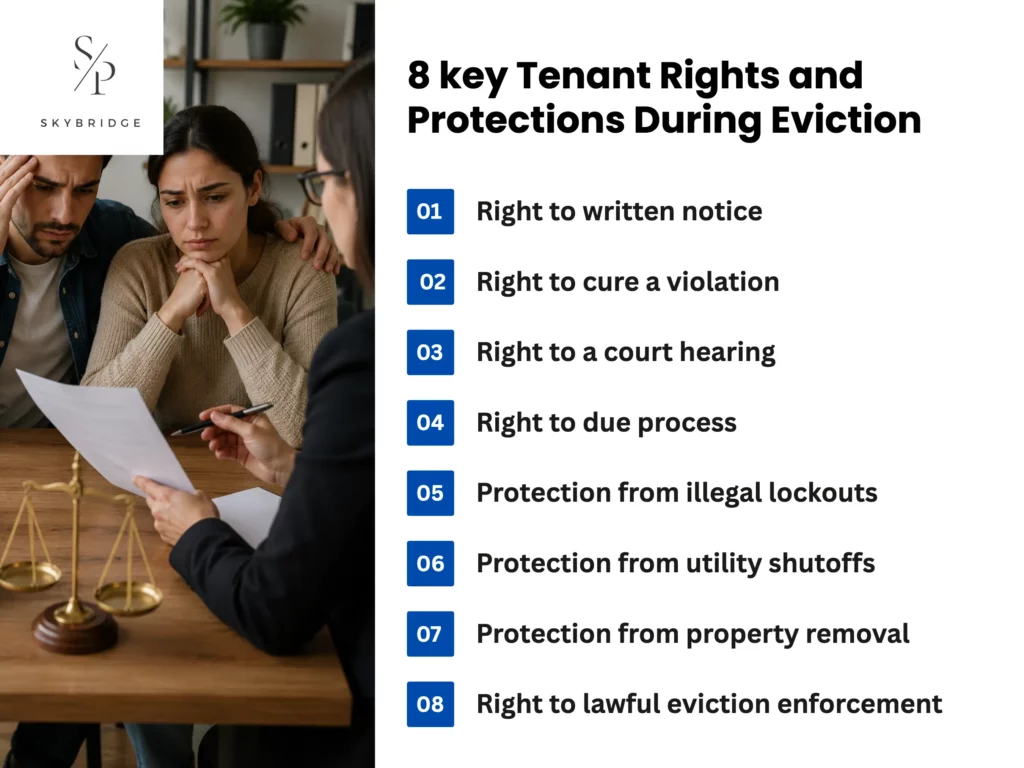
- Right to written notice: Receive a written eviction notice before a lawsuit is filed. For example, nonpayment cases require a 14-day notice period before further legal action can begin.
- Right to cure a violation: Correct certain lease violations or pay overdue rent within the notice period when permitted by law.
- Right to a court hearing: Appear in court, present evidence, respond to the landlord’s claims, and defend against the eviction before a judge.
- Right to due process: Receive proper notice of court proceedings and an opportunity to respond before any eviction order is issued.
- Protection from illegal lockouts: Remain in the property until a court orders eviction and prohibits landlords from changing locks or denying access.
- Protection from utility shutoffs: Continue receiving essential services, such as electricity, water, and gas, during the eviction process.
- Protection from property removal: Prevent landlords from removing, disposing of, or withholding personal belongings without legal authorization.
- Right to lawful eviction enforcement: Be removed from the property only after a court order is issued and enforced through the legal process.
How Much Does It Cost to Evict a Tenant?
The cost to evict a tenant ranges from approximately $1,500 to more than $10,000, depending on the case’s complexity and whether the eviction is contested. Legal fees often represent the largest expense, with attorney costs ranging from flat fees of around $500 to hourly rates of $150 to $400. Additional costs include court filing fees of $50 to $500, service of process fees of $50 to $200, and sheriff or marshal enforcement fees of $50 to $400 or more. Landlords also incur lost rent, property repair, and turnover expenses during the eviction process.
What Mistakes Should Landlords Avoid During Eviction?
Landlords should avoid common mistakes such as illegal self-help evictions, accepting partial rent after notice, improper notice or service, skipping mandatory notice periods, and poor record-keeping, as these actions can delay the eviction process or jeopardize the case.Courts may dismiss an eviction action or require the landlord to restart the process if procedural requirements are not strictly followed.
5 common mistakes landlords should avoid during eviction include:
- Illegal self-help evictions: Do not change locks, shut off utilities, or remove a tenant’s belongings without a court order.
- Accepting partial rent after notice: Understand that accepting partial rent after serving an eviction notice affects the eviction process and could require you to issue a new notice before continuing with the eviction.
- Improper notice or service: Use the correct notice and deliver it through a legally approved method to avoid delays or dismissal.
- Skipping mandatory notice periods: Allow the tenant the full notice period before filing an eviction lawsuit.
- Poor record-keeping: Keep copies of leases, notices, rent records, communications, and proof of service to support the eviction case.
Can a Landlord Evict Without Going to Court?
No, a landlord cannot legally evict a tenant without going to court. Landlords must follow the formal eviction process, which includes serving a written eviction notice, filing an eviction lawsuit, delivering court documents to the tenant, and obtaining a court judgment. Self-help eviction methods, such as changing locks, shutting off utilities, removing belongings, or using intimidation to force a tenant out, are illegal and result in significant legal penalties. A tenant can only be lawfully removed after a court order is issued and enforced by authorized law enforcement.