

To rent with an eviction on your record, be transparent about the eviction, demonstrate financial stability, resolve unpaid landlord debt, and provide additional assurances such as a co-signer or larger security deposit. Strengthen your application by targeting private landlords, avoiding strict automated screening systems, building a renter’s resume, collecting strong references, and reviewing tenant screening reports for accuracy.
Renters can also improve their housing options by disputing inaccurate eviction records, exploring record-sealing opportunities, and using available tenant-assistance resources. Alternative rental options include private landlord rentals, second-chance apartment programs, shared housing arrangements, sublets, corporate housing, and rent-to-own properties. Although an eviction can affect credit reports, background checks, and rental approvals for several years, understanding these challenges and preparing a stronger application can improve your chances of securing housing.
15 steps to rent with an eviction on your record include:
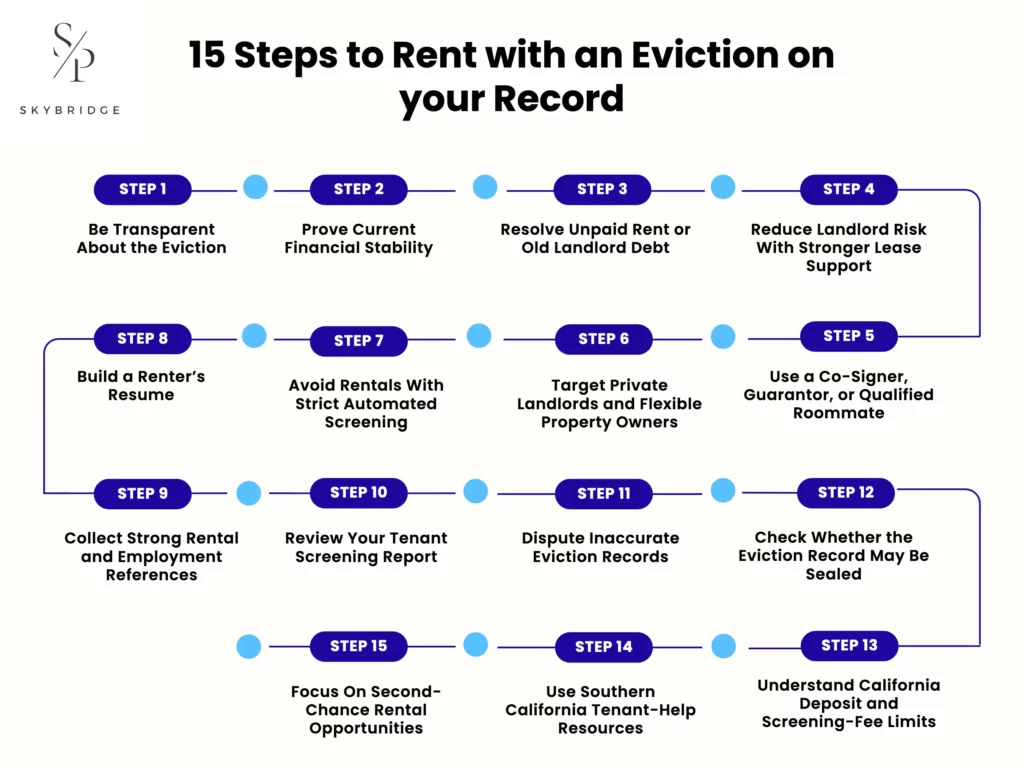
- Be Transparent About the Eviction
- Prove Current Financial Stability
- Resolve Unpaid Rent or Old Landlord Debt
- Reduce Landlord Risk With Stronger Lease Support
- Use a Co-Signer, Guarantor, or Qualified Roommate
- Target Private Landlords and Flexible Property Owners
- Avoid Rentals With Strict Automated Screening
- Build a Renter’s Resume
- Collect Strong Rental and Employment References
- Review Your Tenant Screening Report
- Dispute Inaccurate Eviction Records
- Check Whether the Eviction Record May Be Sealed
- Understand California Deposit and Screening-Fee Limits
- Use Southern California Tenant-Help Resources
- Focus On Second-Chance Rental Opportunities
Be Transparent About the Eviction
Address your eviction history honestly during the application process because landlords often review eviction records as part of tenant screening. Providing a clear explanation helps establish trust, demonstrate accountability, and show that you are prepared to meet future lease obligations.
Key steps to address an eviction record include:
- Disclose the eviction early in the application process instead of waiting for it to appear in a screening report.
- Explain the circumstances surrounding the eviction clearly and factually so prospective landlords understand what happened.
- Accept responsibility for any actions that contributed to the eviction and focus on the lessons learned from the experience.
- Describe the steps you have taken to improve your financial situation, employment status, or rental history since the eviction occurred.
- Highlight positive changes, such as stable employment, increased income, or a consistent record of on-time payments.
- Provide supporting documentation that demonstrates your current financial reliability and ability to pay rent.
- Answer landlord questions honestly and provide additional context when necessary to address concerns.
- Demonstrate your commitment to being a responsible tenant by emphasizing your intention to follow lease terms and make rent payments on time.
Prove Current Financial Stability
Demonstrate your ability to meet rent obligations by providing evidence of stable income and responsible financial management. Showing that you have reliable earnings, sufficient savings, and steady employment reduces concerns about your rental history and strengthens your application.
Key steps to prove current financial stability include:
- Provide recent pay stubs that show consistent income and demonstrate your ability to afford monthly rent payments.
- Submit bank statements that verify you have sufficient funds available to cover rent, utilities, and other living expenses.
- Obtain an employment verification letter that confirms your position, length of employment, and current salary.
- Highlight stable employment history to show that you have a dependable source of income.
- Share proof of additional income sources, such as freelance work, retirement benefits, or investment income, if applicable.
- Demonstrate a history of on-time payments for bills, loans, or other financial obligations to reinforce your reliability.
- Offer a larger security deposit if permitted by local laws and landlord policies to provide additional financial assurance.
- Provide a qualified co-signer or guarantor to support your application and strengthen the landlord’s confidence.
Resolve Unpaid Rent or Old Landlord Debt
Clear any unpaid rent or old landlord debt before applying for a new rental, as outstanding balances can negatively affect tenant screening results. Paying off unresolved debt and documenting the resolution can demonstrate financial accountability and improve your chances of securing a lease despite a prior eviction.
Key steps to resolve unpaid rent or old landlord debt include:
- Review your credit reports and rental history records to identify any outstanding rent balances or landlord-related debts.
- Contact your former landlord or property management company to verify the amount owed and discuss repayment options.
- Negotiate a settlement agreement if paying the full balance is not financially feasible.
- Request written documentation outlining the agreed payment terms before sending any funds.
- Complete the repayment or settlement according to the agreed schedule and retain all payment records.
- Obtain a paid-in-full letter, settlement confirmation, or receipt that verifies the debt has been resolved.
- Keep copies of all correspondence, agreements, and payment confirmations for future rental applications.
- Present proof of debt resolution to prospective landlords to demonstrate that you have addressed past financial obligations responsibly.
Reduce Landlord Risk With Stronger Lease Support
Minimize landlord concerns by offering additional lease protections that demonstrate financial responsibility and a commitment to fulfilling rental obligations. Additional lease protections help offset concerns about an eviction record and increase landlord confidence in your application.
Ways to strengthen your rental application and reduce landlord risk include:
- Offer a larger security deposit, if permitted by state and local laws, to provide additional financial protection for the landlord.
- Prepay several months of rent in advance to demonstrate your ability to meet future rent obligations.
- Use a qualified co-signer or guarantor who can assume financial responsibility if rent payments are missed.
- Agree to a shorter lease term so the landlord can evaluate your reliability before committing to a longer agreement.
- Accept more frequent payment schedules, such as biweekly rent payments, if the landlord is open to alternative arrangements.
- Provide proof of renters’ insurance to show that you are prepared to protect the property and cover certain liabilities.
- Include strong personal, professional, or previous landlord references that can verify your reliability and character.
- Discuss customized lease terms with the landlord that address specific concerns related to your rental history and financial stability.
Use a Co-Signer, Guarantor, or Qualified Roommate
Strengthen your rental application by adding a co-signer, guarantor, or qualified roommate who can provide additional financial support. These arrangements help reassure landlords about your ability to pay rent. Providing qualified lease support can improve credibility and increase your chances of rental approval.
Ways to strengthen your application with a co-signer, guarantor, or qualified roommate include:
- Ask a qualified co-signer to accept responsibility for rent payments if you are unable to meet your lease obligations.
- Secure a guarantor who can provide a financial guarantee and reassure landlords about future rent payments.
- Apply with a qualified roommate who can share the rent and distribute financial responsibility among multiple tenants.
- Choose a co-signer or guarantor with a stable income, strong credit score, and positive rental history.
- Gather proof of income, credit information, and identification documents for any co-signer or guarantor included in the application.
- Confirm that your roommate meets the landlord’s screening requirements before submitting a joint application.
- Discuss financial responsibilities with all parties to ensure expectations are clearly understood before signing the lease.
- Submit all supporting documentation promptly to help landlords verify the financial qualifications of everyone involved.
Target Private Landlords and Flexible Property Owners
Focus on private landlords and independent property owners who often have more flexibility than large property management companies. A professional approach, honest communication, and proof of financial stability can help strengthen your application and improve your chances of securing a rental after an eviction.
Key steps to find rental opportunities through private landlords include:
- Search rental listings that are managed directly by property owners.
- Check local classified ads, community bulletin boards, and neighborhood social media groups for available rentals.
- Use personal and professional networks to identify potential rental opportunities.
- Contact landlords directly to express interest and discuss the property.
- Explain your eviction history honestly and provide relevant context when appropriate.
- Highlight recent improvements in your financial situation and rental reliability.
- Present supporting documents that demonstrate income, employment, and responsible financial management.
- Follow up professionally after conversations or property viewings to reinforce your interest and credibility.
Avoid Rentals With Strict Automated Screening
Prioritize rental properties that use flexible screening methods rather than strict automated systems. Automated screening software often rejects applicants based on preset criteria such as prior evictions or credit score thresholds, leaving little opportunity to explain your circumstances.
Key steps to avoid rentals with strict automated screening include:
- Review rental listings carefully for requirements such as “no prior evictions” or specific minimum credit score thresholds.
- Prioritize properties managed by private landlords and smaller property owners who conduct manual application reviews.
- Contact landlords before applying to ask about their tenant screening process and qualification requirements.
- Focus on rental opportunities that allow direct communication with the property owner or leasing representative.
- Avoid paying nonrefundable application fees for properties that clearly state disqualifying screening criteria.
- Look for landlords who consider employment history, income stability, and rental references alongside screening reports.
- Prepare a clear explanation of your eviction history in case a landlord requests additional context.
- Apply to properties that evaluate applicants individually rather than relying solely on automated screening systems.
Build a Renter’s Resume
Create a renter’s resume that highlights your qualifications, financial stability, and rental reliability. A well-organized resume helps landlords evaluate your application beyond an eviction record by presenting key information in one place. Including employment details, rental history, references, and proof of income can strengthen your application and improve landlord confidence.
Key steps to build a renter’s resume include:
- List your current and previous employment to demonstrate income stability and work history.
- Include your rental history with previous addresses, lease dates, and landlord contact information.
- Add references from former landlords, employers, or professional contacts who can verify your reliability.
- Attach recent pay stubs, bank statements, or other proof of income to support your financial qualifications.
- Highlight positive rental experiences, such as on-time rent payments and lease compliance.
- Include relevant contact information so landlords can easily verify the details provided.
- Organize documents in a clear and professional format that is easy to review.
- Submit the renter’s resume alongside your rental application to provide a complete picture of your qualifications.
Collect Strong Rental and Employment References
Gather references that can verify your reliability, financial responsibility, and rental history. Positive feedback from previous landlords and employers helps landlords evaluate your application beyond an eviction record. Providing credible references who can confirm stable employment, on-time payments, and responsible behaviour can strengthen your application and increase landlord confidence.
Key steps to collect strong rental and employment references include:
- Identify previous landlords who can confirm timely rent payments and compliance with lease terms.
- Request references from employers who can verify your employment status, income stability, and professional conduct.
- Contact references in advance to confirm their willingness to speak on your behalf.
- Provide each reference with information about the rental opportunity so they can offer relevant feedback.
- Include accurate contact information for all references to make verification easier for landlords.
- Select references who have known you for a meaningful period and can provide specific examples of your reliability.
- Organize reference letters, contact details, and supporting documents in a professional application package.
- Submit references alongside your rental application to help landlords verify your qualifications and rental readiness.
Review Your Tenant Screening Report
Check your tenant screening report before applying for a rental to understand what landlords will see during the screening process. Reviewing the report allows you to identify eviction records, credit issues, and rental history details that could affect your application. Correcting inaccuracies in advance can help present a more accurate profile and improve your chances of approval.
Key steps to review your tenant screening report include:
- Request a copy of your tenant screening report from a screening company or credit bureau.
- Review your eviction history to confirm that all records are accurate and up to date.
- Examine your credit report for incorrect balances, payment records, or account information.
- Verify that your rental history contains the correct addresses, dates, and landlord information.
- Look for outdated, duplicate, or inaccurate records that could negatively affect your application.
- Gather supporting documents that can help verify any information you believe is incorrect.
- Contact the reporting agency to dispute and correct any errors you identify.
- Confirm that updates or corrections have been made before submitting new rental applications.
Dispute Inaccurate Eviction Records
Correct any errors in your eviction records before applying for a rental. Inaccurate information in tenant screening reports, credit reports, or court records can affect landlord decisions. Identifying and correcting these issues helps present a more accurate rental profile and supports stronger application outcomes.
Key steps to dispute inaccurate eviction records include:
- Obtain copies of your tenant screening report, credit report, and relevant court records.
- Review all eviction-related information to identify inaccurate, outdated, or duplicate records.
- Gather supporting documents that prove the information is incorrect, such as court orders, payment records, or settlement agreements.
- Contact the tenant screening company or credit bureau that reported the inaccurate information.
- Submit a formal dispute explaining the error and providing supporting documentation.
- Follow up with the reporting agency to track the status of your dispute request.
- Request written confirmation once the inaccurate information has been corrected or removed.
- Verify that updated reports accurately reflect the corrections before applying for new rental opportunities.
Check Whether the Eviction Record May Be Sealed
Determine whether your eviction record qualifies for sealing or expungement under local laws. A sealed record is generally removed from public view and does not appear in most tenant screening reports. If eligible, sealing an eviction record can improve rental prospects and reduce screening-related challenges.
Key steps to determine whether an eviction record may be sealed include:
- Review the outcome of your eviction case to determine whether it was dismissed, resolved in your favor, or qualifies for record sealing.
- Research state and local laws governing eviction record sealing or expungement.
- Obtain copies of court records related to the eviction case.
- Verify whether you meet the eligibility requirements established by the court or local regulations.
- Gather supporting documents that strengthen your request for sealing or expungement.
- File a petition or application with the court that handled the eviction case.
- Attend any required hearings or provide additional information requested by the court.
- Request confirmation once the court approves the sealing or expungement of the eviction record.
Understand California Deposit and Screening-Fee Limits
Learn about California’s security deposit and screening fee regulations before applying for a rental. These rules limit certain upfront costs and help protect tenants from excessive charges. Knowing the applicable requirements can help you budget effectively, recognize improper fees, and make informed rental decisions.
Key steps to understand California deposit and screening-fee limits include:
- Familiarize yourself with current California laws governing security deposits and tenant screening fees.
- Compare the deposit amount requested by a landlord with the limits permitted under state law.
- Calculate your expected upfront rental costs before submitting an application.
- Review all application-related charges to understand what fees you are being asked to pay.
- Keep records of deposits, screening fees, and other rental expenses throughout the application process.
- Discuss any unclear or unexpected charges with the landlord before making a payment.
- Stay informed about changes to California rental laws that could affect deposit and screening-fee requirements.
- Seek assistance from tenant advocacy organizations or legal resources if you have concerns about excessive fees or deposits.
Use Southern California Tenant-Help Resources
Connect with tenant-help organizations in Southern California to access guidance, legal assistance, and housing support during your rental search. These resources can help you understand tenant rights, address eviction-related challenges, and strengthen your rental application.
Key steps to use Southern California tenant-help resources include:
- Identify local legal aid organizations that provide assistance with eviction-related matters and tenant rights.
- Contact housing authorities to learn about rental assistance programs and housing opportunities in your area.
- Seek guidance on reviewing public records, tenant screening reports, and eviction-related documentation.
- Request information about state and local laws that affect renters with a prior eviction.
- Work with nonprofit organizations to develop strategies for improving your rental application.
- Obtain assistance with communicating your circumstances to prospective landlords.
- Explore programs that provide financial counseling, rental assistance, or housing placement support.
- Use available resources early in your housing search to strengthen your chances of securing a rental.
Focus On Second-Chance Rental Opportunities
Prioritize second-chance rental opportunities designed for applicants with past evictions or challenging rental histories. T Demonstrating financial stability, responsible rent payment habits, and improved circumstances can help increase your chances of approval.
Key steps to find second-chance rental opportunities include:
- Search for landlords, apartment communities, and housing programs that advertise second-chance rental options.
- Prioritize private landlords and property owners who evaluate applications on a case-by-case basis.
- Prepare documentation that demonstrates stable income, employment, and financial responsibility.
- Highlight positive rental references and recent improvements in your rental history.
- Be prepared to explain the circumstances surrounding a previous eviction honestly and professionally.
- Review application requirements carefully to understand deposit, income, and screening expectations.
- Apply to multiple second-chance housing opportunities to expand your rental options.
- Follow up with landlords and property managers to reinforce your interest and qualifications.
What Types of Rental Options Are Available if You Have an Eviction?
The types of rental options that are available if you have an eviction include private landlord rentals, co-signed leases, shared housing arrangements, sublets, family-supported leases, second-chance apartment programs, extended-stay housing, and rent-to-own properties. These options often provide greater flexibility than traditional rentals and can help renters secure housing while rebuilding their rental history and financial profile.
Below are the 8 types of rental options that are available if you have an eviction:
- Renting from Private or Independent Landlords: Private or independent landlords are often among the best rental options for applicants with an eviction on their record because they can evaluate the full rental application rather than relying exclusively on automated screening systems. Renters can explain past circumstances, present proof of financial stability, and demonstrate improvements in their rental history.
- Renting With a Cosigner or Guarantor: Renting with a cosigner or guarantor can improve approval chances by providing landlords with additional financial security. A qualified cosigner or guarantor agrees to cover rent obligations if payments are missed, helping reduce concerns related to a previous eviction or credit challenges.
- Roommate or Shared Housing Arrangement: A roommate or shared housing arrangement can make renting more accessible by reducing individual housing costs and financial risk. Sharing rent responsibilities with other occupants can strengthen the overall application and make landlords more comfortable approving the lease.
- Subletting an Apartment: Subletting an apartment can provide a practical housing solution for renters who face challenges with traditional rental applications. Some sublease opportunities involve less restrictive screening requirements and offer a way to secure housing while rebuilding rental history.
- Renting With a Family Member as Leaseholder: Renting with a family member as the primary leaseholder can help satisfy landlord qualification requirements when an eviction affects eligibility. A family member with strong credit, a stable income, and a positive rental history can lend credibility to the housing application.
- Second-Chance Apartment Programs: Second-chance apartment programs are specifically designed for renters with prior evictions, credit issues, or other rental history challenges. These communities often consider current financial stability, employment, and references, as well as past rental records.
- Corporate or Extended Stay Housing: Corporate and extended-stay housing can provide temporary accommodation for renters who need a place to stay while improving their rental profile. These options often place greater emphasis on current payment ability and immediate housing needs than long-term rental history.
- Rent-to-Own Housing Options: Rent-to-own housing allows renters to secure a home while working toward future ownership. Some property owners offering these arrangements focus more on present financial qualifications and consistent payments than on past eviction records.
What Are the Main Challenges of Renting With an Eviction on Your Record?
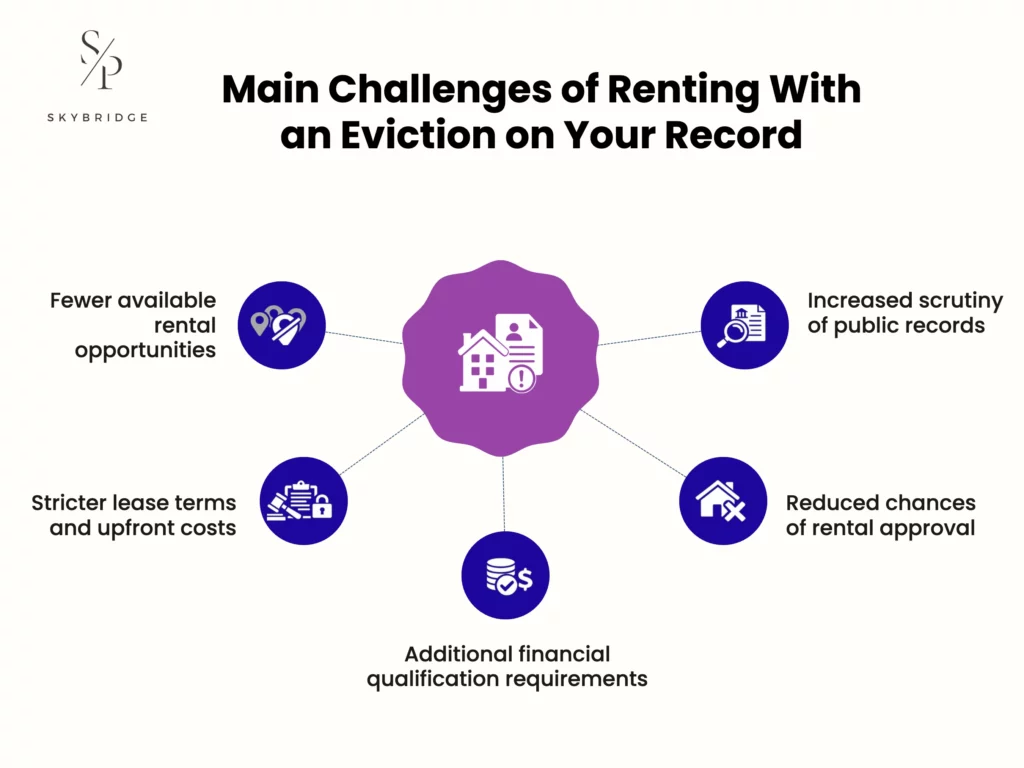
The main challenges of renting with an eviction on your record include increased screening scrutiny, reduced approval opportunities, additional financial requirements, stricter leasing conditions, and a smaller pool of available rental properties. These obstacles can make the rental process more competitive and require applicants to provide stronger evidence of financial stability and rental reliability.
Below are the 5 common challenges of renting with an eviction on your record:
- Increased scrutiny of public records: Landlords frequently review tenant screening reports, court records, and credit reports for signs of previous evictions. A past eviction often prompts a more detailed review of an applicant’s rental and financial history.
- Reduced chances of rental approval: Many property owners consider eviction history when evaluating applications. Concerns about missed rent payments or lease violations can make landlords less likely to approve an applicant.
- Additional financial qualification requirements: Applicants with an eviction record are often asked to provide a cosigner, guarantor, or proof of higher income. These requirements help landlords reduce perceived financial risk.
- Stricter lease terms and upfront costs: Some landlords require larger security deposits, shorter lease agreements, or alternative payment arrangements. These conditions provide additional protection for the property owner.
- Fewer available rental opportunities: Certain apartment communities and property management companies have policies that restrict applicants with prior evictions. This limitation can narrow housing options and extend the rental search process.
How Does an Eviction Affect Your Credit and Background Checks?
An eviction can affect both credit and background checks because landlords often review tenant screening reports, public records, and credit history during the rental application process. Unpaid rent or outstanding balances related to an eviction can also appear on credit reports.
8 key ways an eviction can affect your credit and background checks include:
- Appear in tenant screening reports that landlords use to evaluate rental applications.
- Create public records that property owners and property managers can access during the screening process.
- Result in collection accounts if unpaid rent or damages are transferred to a collection agency.
- Lower your credit score when eviction-related debt is reported to credit bureaus.
- Increase landlord concerns about financial stability and future rent payment reliability.
- Trigger additional screening requirements, such as reference checks or proof of income verification.
- Reduce approval chances with landlords who have strict rental history requirements.
- Require applicants to provide stronger documentation that demonstrates financial responsibility and positive rental behavior since the eviction occurred.
How Can You Dispute an Eviction From Your Record?
To dispute an eviction from your record, review your tenant screening reports, credit reports, and public records for inaccurate information. Correcting errors can help ensure landlords see accurate rental history during the screening process.
8 key steps to dispute an eviction from your record include:
- Obtain copies of your credit report, tenant screening report, and relevant court records.
- Review all eviction-related information for incorrect dates, balances, case details, or records that do not belong to you.
- Gather supporting documents, such as court records, payment receipts, settlement agreements, or letters from previous landlords.
- Contact the credit bureau or tenant screening agency that reported the inaccurate information.
- Submit a formal dispute explaining the error and providing supporting documentation.
- Monitor the dispute process and respond promptly to any requests for additional information.
- Verify that corrections have been made once the investigation is complete.
- Request updated reports to confirm that inaccurate eviction information has been removed or corrected.
How Can You Remove an Eviction From Your Record?
To remove an eviction from your record, identify inaccurate information, resolve outstanding obligations, and explore available legal options for record correction or removal. Taking these steps can help reduce the impact of an eviction on future rental applications.
Follow these 7 steps to remove an eviction from your record:
- Review public records, tenant screening reports, and credit reports for eviction-related information.
- Dispute inaccurate or outdated records with the appropriate reporting agency or court.
- Resolve unpaid rent balances or settlement agreements when applicable.
- Obtain documentation that confirms payment, settlement, or case resolution.
- Contact your previous landlord to request an update to the record after resolving any outstanding issues.
- Research eviction record sealing or expungement options available in your state.
- Keep records that demonstrate positive rental history and financial responsibility moving forward.
How Long Does an Eviction Stay on Your Record?
An eviction stays on your record for up to 7 years, although the exact timeframe can vary depending on state laws and reporting practices. During this period, landlords, property managers, and tenant screening companies may see the eviction when reviewing rental applications. Court records often retain eviction information for the full reporting period, while eviction-related debts can also affect credit reports and credit scores. Understanding how long an eviction remains visible can help renters prepare for future housing applications and plan strategies to improve their rental prospects.
How Can You Improve Your Rental Chances With an Eviction on Your Record?
You can improve your chances of securing a rental with an eviction on your record by demonstrating financial stability, providing strong references, and proactively addressing landlord concerns. Demonstrating reliability and responsibility can help strengthen your application and improve approval prospects.
8 crucial steps to improve your rental chances include:
- Provide references from previous landlords or employers.
- Show proof of income through pay stubs, bank statements, or employment verification.
- Offer a larger security deposit if permitted.
- Use a qualified co-signer or guarantor for additional financial support.
- Explain the eviction honestly and highlight positive changes since it occurred.
- Present evidence of on-time rent payments and responsible financial behavior.
- Prepare a renter’s resume with supporting documents and references.
- Apply to landlords who consider applicants on a case-by-case basis.